

The registration tool that fills your attendee list may still leave your exhibition entrance unprepared. A visitor check-in system UAE venues choose needs to do more than record sign-ups: it should support a clear on-site entry workflow without turning security checks into a bottleneck.
That distinction matters. Registration happens before visitors arrive; check-in and entry management shape what happens at the door. You want to protect the venue while giving visitors and staff a process that feels straightforward and transparent.
This guide gives you a practical way to compare exhibition check-in needs, security workflows and digital visitor management features. You’ll learn which functions belong to registration and which support arrival and entry, what to consider when handling visitor information under the UAE’s Personal Data Protection Law, and how to assess a system against your venue’s workflow. MyGatePass brings together dedicated visitor and security apps, an admin dashboard and a UAE Pass integration module for verified visitor identification. These capabilities are distinct from event ticketing, badge printing and physical access hardware, which you can assess separately.
Key Takeaways
- Assess a visitor check-in system UAE venues can use by matching features to real arrival needs, not by choosing the longest feature list.
- Compare manual logs, event registration tools, visitor management software and physical access control by the role each plays in the entry process.
- Map visitor types, arrival patterns and staff responsibilities to spot friction points before selecting a workflow.
- Consider identity handling, staff usability, admin visibility and personal data management as separate decision criteria.
- MyGatePass Visitor App, Security App and Admin Dashboard support a connected visitor management operation.
What Should a UAE Exhibition Check-In System Do?
An exhibition entrance has a simple goal: help each visitor move from arrival to entry through a process staff can understand and manage. A visitor check-in system UAE organisers assess should support that arrival-stage workflow by recording who has arrived and helping staff handle the next step clearly. It should fit the event’s security process, without blurring it with registration or implying that every check happens automatically.
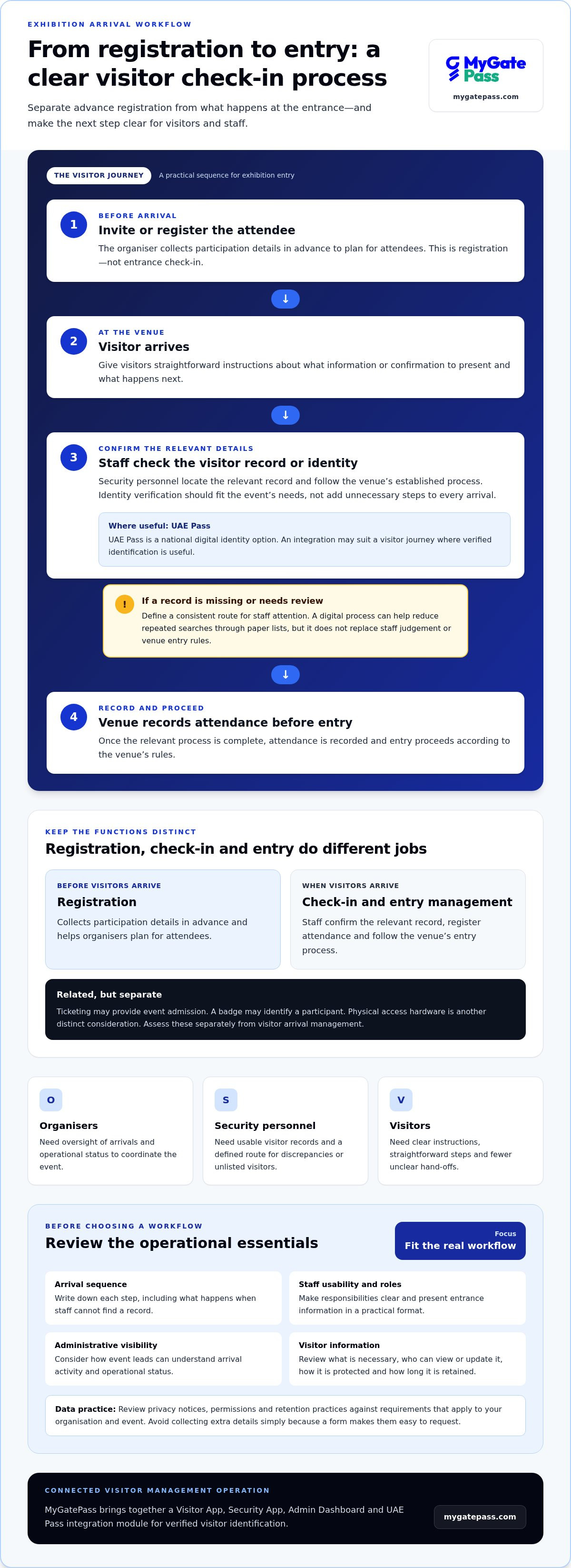
Think of the visitor journey as connected stages: an organiser invites or registers an attendee, the attendee arrives, staff confirm the relevant visitor record or identity, and the venue records attendance before entry proceeds. A clear digital process can reduce repeated searches through paper lists and help staff know what to do when a record is missing or needs review. It doesn’t replace staff judgement or the venue’s entry rules.
A visitor management system generally supports the recording and oversight of arrivals. For exhibitions, the useful question is how that record fits the visitor journey and the people managing the entrance.
Where registration ends and visitor check-in begins
Registration collects participation details in advance, such as the information an organiser needs to plan for attendees. Check-in happens when someone arrives: staff follow the established process to confirm the relevant record and register attendance. Keeping the stages distinct helps teams assign responsibilities and choose tools for each task, rather than expecting one function to cover the entire event.
Ticketing, badge printing and entry management are related but separate. A ticket may provide event admission; a badge may identify a participant; entry management determines how the venue handles arrival and verification. Treating them as distinct makes it easier to identify hand-offs and spot where a manual lookup could create uncertainty.
Who needs the system during an exhibition?
Different people need different views of the same arrival process. Organisers need oversight of arrivals and operational status to coordinate the event. Security personnel need clear, usable visitor records at the point of entry and a defined route for exceptions. Visitors need to know what information or confirmation to present and what happens next.
- Organisers: Clarify which arrival information helps them understand event operations.
- Security personnel: Make records easy to locate and define how to handle discrepancies or unlisted visitors.
- Visitors: Keep instructions straightforward, without repeated questions or unclear hand-offs.
Before selecting software, write down the sequence staff and visitors should follow, including what happens when a record cannot be found. This reveals whether the need is advance registration, arrival recording, identity verification or a combination of separate tasks. It also gives the team a practical basis for comparing features.
Which Exhibition Check-In Features Matter Most in the UAE?
Feature lists can quickly become overwhelming. Start with the exhibition’s arrival workflow, then assess identity handling, staff usability, administrative oversight and data practices as separate needs. Choose capabilities that solve a defined operational problem, rather than focusing on features that may not apply to your venue.
The UAE exhibitions and conferences industry is a significant part of the country’s event landscape. That context makes an organised arrival process valuable, but it doesn’t mean every venue needs the same tools. A focused review helps identify the right balance of verification, visibility and visitor convenience for your event.
Identity verification and visitor convenience
Identity checks can help staff work from clearer visitor records, especially when an event has different attendee types or entry rules. In the UAE, UAE Pass is a national digital identity option; an integration may suit a visitor journey where verified identification is useful. Consider which visitors need verification, when it should happen and how staff should handle exceptions. The check should support confidence without adding unnecessary steps to every arrival.
For a closer look at identity workflows in building operations, see this UAE Pass building integration and compliance guide. Keep the event experience in view: explain what visitors should expect, make the next step clear and define a consistent alternative process for cases that need staff attention.
Admin visibility, staff workflows, and data handling
Administrative visibility helps event leads understand arrival activity and operational status without relying on disconnected updates. At the entrance, security personnel need access to information relevant to their role, presented in a practical format. A centralized view for administrators and clear role-based access for staff can make responsibilities easier to follow when the workflow matches how the venue operates.
Data handling deserves its own review. Before choosing a system, consider what visitor information is necessary, who should be able to view or update it, how it is protected and how long it is retained. Review privacy notices, permissions and retention practices against the requirements that apply to your organisation and event. Avoid collecting extra details simply because a form makes them easy to request.
- Identity: Match the verification method to event entry needs and define an exception path.
- Usability: Check whether staff can find the right record and understand the next action.
- Administration: Identify which arrival statuses organisers need to oversee.
- Hardware: Assess software records and workflows separately from gates, turnstiles and other physical equipment.
- Data: Limit access and collection to what the process requires, and set clear retention practices.
A visitor check-in system UAE venues consider should fit the entry operation, not dictate it. The MyGatePass visitor management platform supports a software-based approach to visitor management.
How Do Manual Logs, Event Tools, and Visitor Systems Compare?
These approaches solve different parts of an exhibition’s arrival process. A manual log records visitors at the door, an event registration platform prepares attendee details in advance, visitor management software supports arrival operations, and physical access control governs passage through venue entry points. They may work alongside one another, but none should be assumed to replace every other tool.
Compare them by the task they support, rather than by a broad label such as “event software.” A visitor check-in system UAE organisers are considering should fit the venue’s real workflow and make clear where staff still need a separate process or device.
| Approach | Arrival workflow | Identity handling | Staff workload | Administrative visibility |
|---|---|---|---|---|
| Manual visitor log | Staff record arrivals on paper or in a basic document. | Staff review the details provided; checks depend on the venue’s procedure. | Simple to start, but staff may need to search or update records manually. | Records may need to be gathered or reviewed separately. |
| Event registration platform | Collects attendee information before the event; on-site check-in depends on the platform’s functions. | Stores registration details, but this doesn’t automatically establish an entry-verification process. | Can help prepare attendee information; arrival tasks may remain separate. | Provides a view of registration information according to its functions. |
| Visitor management software | Supports recording and managing visitor arrivals. | Can support a defined identity workflow, depending on the system and setup. | Organises visitor records for staff use; the venue still sets its procedures. | May provide an administrative view of visitor operations. |
| Physical access control | Controls passage through an equipped entry point. | Depends on the credentials and configuration used at the venue. | Supports the physical entry process, but doesn’t necessarily manage attendee registration. | Visibility depends on the access-control setup and its records. |
When a manual visitor log is enough, and when it is not
A manual log may suit a low-complexity entrance where staff record a small, straightforward set of arrivals and need only a basic attendance record. Its simplicity can be useful when the workflow is easy to oversee. Coordination becomes harder if staff repeatedly search separate lists, write updates in different places or reconcile records across teams. The question is whether manual logging gives your team the visibility and consistency the event requires.
How visitor management complements event registration
Registration prepares the attendee list; visitor management focuses on arrival operations. For example, an organiser may collect participation details before the exhibition, while entry staff follow a separate process to locate the visitor record and manage arrival. Ticketing, badge printing and physical access equipment may also sit alongside these functions. Map each hand-off before deciding what needs to connect and what remains a separate operational task.
For related context on visitor access in hospitality settings, explore this digital gate pass app guide for UAE hospitality standards. The right combination supports your event’s actual process without expecting a single platform to perform every registration, verification and hardware function.
How to Evaluate an Exhibition Check-In Workflow Before Choosing
Assess the process before comparing product screens. A practical evaluation shows where information comes from, who acts on it and what happens when an arrival doesn’t follow the expected path. That gives your team a clear basis for deciding whether a visitor check-in system UAE venues are considering fits the operation, rather than forcing staff to adapt to a workflow that doesn’t match the event.
Map the visitor journey and operational roles
Start with the people arriving and the decisions staff must make. List attendee categories, such as registered visitors, exhibitors, contractors or invited guests, where they apply to your event. Then map the hand-offs between organisers, reception and security personnel, from advance registration through identity checks and attendance records. Note who handles missing details, unclear identity information or other exceptions, so staff aren’t left guessing at the entrance.
- Identify visitor types and arrival patterns. Record who is expected, when arrivals are likely to cluster, and whether different groups follow different entry instructions. Use actual event plans rather than assumptions.
- Assign entry responsibilities. Identify who can review visitor records, who carries out required checks, and who decides how an exception should be handled. Make escalation clear before event day.
- Draw the current journey. Map each hand-off from registration to arrival, verification, entry and attendance recording. Mark where staff switch between tools or repeat a lookup.
- Define the information rules. Decide which records each role needs, who may access or update them, and how long information should be kept under the organisation’s retention practices.
Test the workflow with clear acceptance criteria
A written process can look tidy and still be confusing at the door. Walk staff through realistic scenarios before finalising it: a visitor whose registration details are unavailable, an identity question that needs review, and a straightforward arrival. Observe whether staff know what to do, whether visitor instructions are easy to follow and whether the organiser can understand the resulting record and operational status.
Set acceptance criteria in plain language. Staff should be able to identify their next action without relying on informal workarounds; visitors should receive consistent instructions; administrators should be able to interpret records; and exceptions should have a named decision-maker. If a scenario exposes ambiguity, adjust the process and repeat the walkthrough.
Review data access, security and retention against the requirements that apply to your organisation. For UAE operations, assess current data-protection guidance, including the federal Personal Data Protection Law where applicable; certain free zones have separate data-protection regimes, so the relevant rules can depend on the entity and venue. Keep the assessment specific to your circumstances rather than assuming one checklist covers every organisation.
Four-stage checklist: define visitor categories and arrival patterns, assign decision-makers, test normal and exception journeys, then review record access and retention against applicable requirements.
MyGatePass visitor management software supports organised visitor operations through dedicated visitor and security apps and a central admin dashboard.
How MyGatePass Supports a More Connected Visitor Check-In Operation
A well-managed arrival depends on clear roles, accessible information and a process staff can follow consistently. MyGatePass brings visitor and security apps together with a centralized administration component in a digital visitor and facility management ecosystem. For venues assessing a visitor check-in system UAE teams can use, the platform connects the people involved in visitor operations while keeping each task distinct.
Connect visitor, security, and administration workflows
MyGatePass Visitor App is the visitor-facing part of the platform, while MyGatePass Security App is designed for security personnel. These dedicated apps give each group a relevant point of interaction with visitor management. The MyGatePass Admin Dashboard provides a centralized place for administration and a clear view of the operation.
Consider how those roles relate at your venue. Visitors need a process they can understand; security personnel need usable visitor information for their entry responsibilities; administrators need oversight of the operation. Matching the tools to those roles can help clarify hand-offs and responsibilities. The platform doesn’t replace your venue’s procedures, staff decisions or physical access equipment.
MyGatePass also includes a UAE Pass Integration Module for verified visitor identification. This is relevant where identity verification forms part of the venue’s visitor workflow. Decide how it fits the journey, which visitor interactions require verification and how staff should handle cases that need attention. The module supports an identity step; it is separate from event registration or ticketing.
Choose a digital visitor management foundation for your venue
The buying framework in this guide starts with the operation, not the feature list. Define visitor groups and arrival responsibilities, separate advance registration from on-site entry, and identify what administrators and security personnel need to see. Then assess privacy practices and test the process with realistic scenarios. This sequence helps you judge whether a platform suits your venue’s requirements without assuming it also supplies badge printing, ticketing, QR scanning or physical access hardware.
MyGatePass is a digital visitor and facility management platform, with additional delivery management and staff attendance tools within its wider software suite. Keep your evaluation focused on the workflows you need to manage and how the visitor, security and administration components can support them. A connected foundation can give staff a clearer process and make arrivals more straightforward for visitors.
Make Every Arrival Feel Well Managed
Your exhibition entrance is often a visitor’s first in-person interaction with the event. Set a confident tone by making the next step clear, giving staff a workflow they can follow and keeping the experience welcoming while meeting venue requirements. The right visitor check-in system UAE teams choose should fit the way people actually arrive, not add another layer of process.
MyGatePass connects dedicated visitor and security apps with a centralized admin dashboard and a UAE Pass integration for verified visitor identification. Together, these components provide a digital foundation for organising visitor operations while keeping your venue’s own procedures at the centre.
To explore a more connected approach for your venue, explore the MyGatePass visitor management platform.
Frequently Asked Questions
Can an exhibition check-in system replace attendee registration?
Not necessarily. Registration prepares an attendee record before the event, while check-in deals with the visitor’s arrival. A platform may support both, but organisers should trace the steps from sign-up to entry to see what it covers. For example, if registration confirms participation but staff still need to verify a visitor at the venue, that arrival task needs its own defined process, whether it uses the same software or a separate system.
Does UAE Pass work for every exhibition visitor?
Don’t assume every visitor will use the same identity route. UAE Pass is a UAE digital identity option, but an exhibition may welcome people with different circumstances or needs. Before the event, decide what instructions visitors receive, which identity options the workflow supports and who can assist if a visitor can’t follow the expected route. Keep guidance aligned with the integration setup and relevant eligibility details rather than making a universal claim.
How can an exhibition reduce queues at visitor check-in?
Reduce avoidable pauses by making each arrival step clear before visitors reach the desk. Tell attendees what information to have ready, separate routine arrivals from cases needing staff review, and assign a clear person to resolve exceptions. Then run a walkthrough with staff using realistic scenarios. Note where visitors wait or repeat information during the test, and adjust the hand-offs. Don’t promise a specific time saving without event-specific evidence.
What should an exhibition check-in system include?
Start with the functions your entry process genuinely needs: identity handling, staff usability, administrator visibility, appropriate data access and a workable relationship with registration. A visitor check-in system UAE venues assess should also make clear what it doesn’t do. A digital visitor record isn’t automatically a ticket, printed badge or signal that a turnstile should open. Keep each requirement separate in your evaluation so the final setup covers the full journey.
Is visitor check-in software the same as access control?
No. Visitor check-in software organises information and steps around an arrival; access control governs permission to pass through a physical entry point. A venue might use visitor software to manage records while separate access equipment controls a door. During planning, specify what staff decide, what the software records and what any physical control does. This avoids assuming that a visitor record alone grants entry or that access equipment manages attendee details.
How should UAE venues assess visitor data privacy for check-in?
List the information collected at each step, the staff roles that need it and the purpose for keeping each record. For instance, distinguish details needed to resolve an arrival from information collected for event planning. Set access permissions accordingly and document retention practices. Review the workflow against current requirements applicable to your organisation and venue, and rely on authoritative guidance for legal interpretation. Don’t assume one general privacy checklist fits every operating context.
Can a visitor management platform support an exhibition security team?
Yes, it can support the team’s digital workflow when its functions align with the venue’s responsibilities. Consider a practical scenario: security staff need to locate a visitor record, follow the venue’s identity procedure and know where to direct an exception. Assess how the platform supports those steps and what administrators can oversee. MyGatePass provides dedicated visitor and security apps, an admin dashboard and UAE Pass integration for verified visitor identification.


