

A signature alone won’t make hazardous work safe. On a UAE site, a permit to work system defines the task, equipment, authorized workers, safety precautions, and permit validity period before work begins. It also sets out how the work is completed and the permit is closed.
That structure matters when contractors, site teams, and work groups need to coordinate safely. The permit should make responsibilities and controls clear, so workers know what is allowed and what happens next.
This guide explains how the system works, who manages and authorizes permits, and how permits support contractor coordination and searchable records. It also covers electrical, hot-work, confined-space, and work-at-height permits, including controls teams can use to prepare for higher-risk tasks.
Key Takeaways
- Define the task, equipment, authorized workers, safety controls, and permit validity before work begins.
- Coordinate contractors by making responsibilities clear, especially when work or accountability passes between teams.
- Use controls suited to the hazard: electrical isolation, fire precautions, confined-space preparation, or fall prevention.
- Track each permit from issue through clearance, cancellation, or extension, and keep the related work records searchable.
- Assign a competent manager to authorize the work, set its controls, and account for any concurrent permits.
Contractor and site management
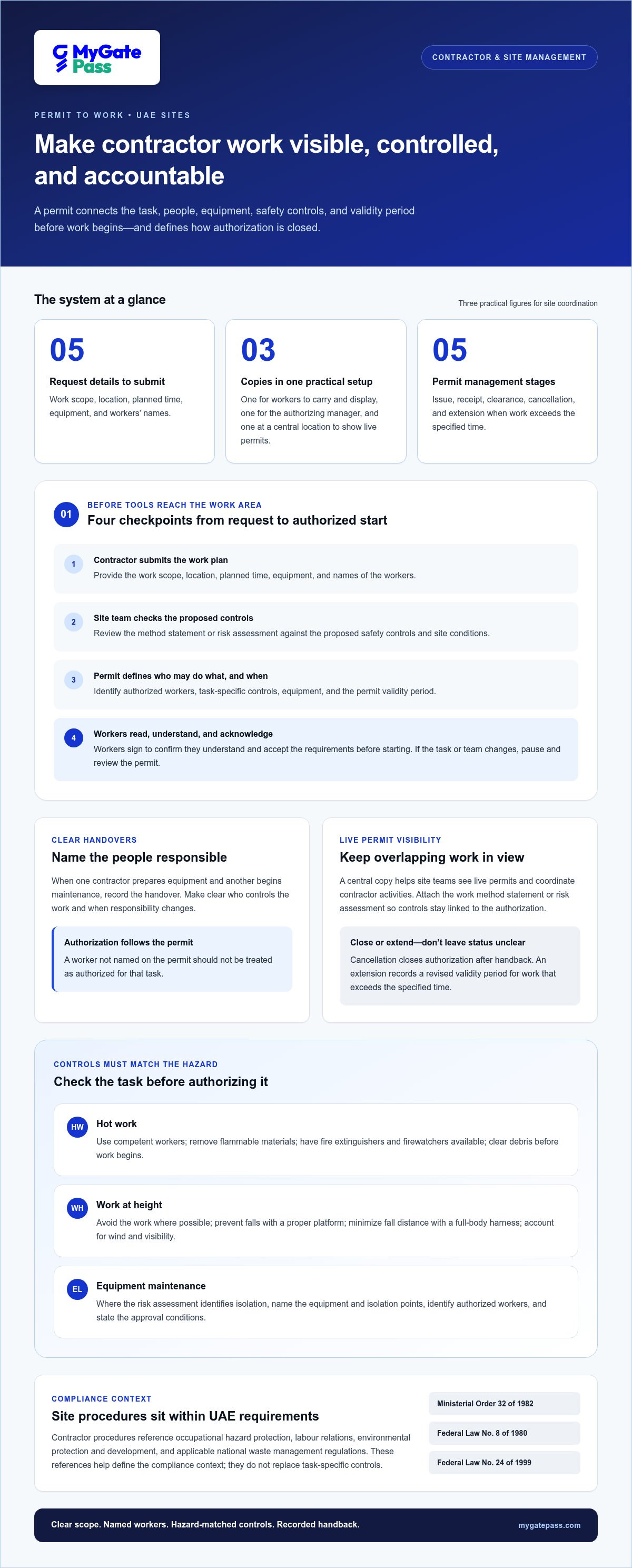
On a UAE site, contractor coordination starts before tools reach the work area. The site team identifies the task, location, equipment, contractor, and people responsible for control. A permit to work system is especially useful when responsibility passes between groups, such as when one contractor prepares equipment and another begins maintenance. Recording the handover clarifies who controls the work and when that responsibility changes.
Contractors working under standard operational procedures must comply with UAE Ministerial Order 32 of 1982, which concerns employee protection against occupational hazards. The same procedures require adherence to national environmental, health, and safety management frameworks. They also align with UAE Federal Law No. 8 of 1980 on labour relations, UAE Federal Law No. 24 of 1999 for environmental protection and development, and applicable national waste management regulations. These references help define the site's compliance context; they are not a substitute for task-specific controls.
Contractor permit access should follow a clear sequence. First, the contractor submits the work scope, location, planned time, equipment, and workers’ names. The site team then checks the method statement or risk assessment against the proposed controls. The permit identifies authorized workers and its validity period. Before work starts, workers read the controls and sign to confirm they understand and accept the requirements. If the task or team changes, pause and review the permit before continuing.
Treat contractor eligibility as a documented site decision, not an assumption based on company attendance. The authorizing manager can compare the named workers, task scope, and risk controls with the planned work. For example, a contractor assigned to equipment maintenance should have the correct permit and isolation details before entering the work area. A worker not named on the permit should not be treated as authorized for that task. Clear records, often managed efficiently through platforms like MyGatePass, help keep access decisions consistent across shifts and contractor teams.
Use the permit stages to manage access from start to finish: issue, receipt, clearance, cancellation, and extension. An extension can cover work that exceeds the specified time, while cancellation closes authorization after handback. One practical three-copy arrangement gives workers a copy to carry and display, keeps one with the authorizing manager, and places one at a central location to show live permits. This helps site teams see active work and coordinate overlapping contractor activities. Attach the work method statement or risk assessment so its controls remain linked to the authorization.
Task-specific checks should reflect the hazards involved. Hot-work controls include using competent workers, removing flammable materials, having fire extinguishers and firewatchers available, and clearing debris before work begins. Work-at-height controls should avoid the work where possible, prevent falls with a proper platform, minimize fall distance with a full-body harness, and account for wind and visibility. Check these controls before authorizing the task. UAE employment visas are typically valid for two or three years, depending on the employment contract and sponsorship terms.
What Is a Permit To Work System?
A permit is a controlled authorization for specified work, equipment, workers, precautions, and a validity period. A job safety analysis or risk assessment identifies hazards and controls; the permit records approval to proceed under those controls.
Digital Permit Request and Closure
A digital workflow can guide a request through defined stages: submission, review, approval, active work, and closure. The request should identify the task, location, equipment, workers, precautions, and validity period. Reviewers can then assess the proposed work against its risk assessment or method statement before approving it.
Once authorized, workers should read the controls and acknowledge the requirements before starting. When work is complete, workers should follow the site's handback process and leave the work area in the required condition. The authorizing manager accepts the handback and cancels the permit, closing authorization for the task.
For unfinished work, an extension records a revised validity period instead of leaving an expired authorization in use. Check that the digital record preserves every change, approval, handback, and cancellation. This sequence makes permit status clear to people coordinating work across shifts.
Permits Compared with Safety Assessments
A job safety analysis or risk assessment examines hazards, evaluates exposure, and sets controls for a task. A work permit turns those controls into an operational authorization tied to a defined location, equipment, workers, and time. Attach the assessment or method statement to the permit to keep the controls connected to the work.
For example, an assessment may identify the need to isolate equipment before maintenance. The permit names the equipment and isolation points, identifies authorized workers, and sets out the approval conditions. Neither document replaces the other: one analyzes the risk, while the other controls whether and how work proceeds.
When evaluating a digital workflow, look for a clear link between the assessment and the permit. Reviewers should be able to see task-specific controls, not just a generic approval status. Workers should be able to acknowledge the requirements before starting.
Work Permit Authorization and Management
A competent authorizing manager specifies the work, location, workers, control measures, permit date and time, validity duration, and concurrent permits. That scope lets the manager assess whether the request matches site conditions and whether another active job may affect it.
Work outside a plot limit needs explicit review before it proceeds. The request should identify the boundary, affected area, work scope, and nearby activities. The responsible manager can then determine which site controls and approvals apply. Approval for work inside a plot does not authorize work beyond the stated boundary.
For example, a task that moves from a designated work area into a shared access route changes location and may affect other teams. Update the request and obtain approval for the revised scope before continuing. A digital record should show who authorized the change and when, keeping the permit aligned with the work taking place.
Audit trails and searchable records
A permit record should document the process from request through completion. This trail helps site teams see who submitted the work, who reviewed it, which controls applied, and how the job ended. In a digital register, consistent fields make records easier to find by work area, contractor, task, equipment, or status. That makes the record useful for coordination, not just filing.
Record the decisions that shape authorization. For example, a maintenance permit might identify the equipment, isolation details, named workers, control documents, authorizing manager, and validity period. If the task changes, record the revised scope and approval. If work exceeds its specified time, record the extension. These entries let reviewers follow the permit’s history without relying on separate messages or memory.
A practical audit trail can include:
- The work request, location, task scope, and contractor details.
- The risk assessment or method statement linked to the work.
- The reviewing manager’s decision and any required changes.
- Worker acknowledgement, handback, and permit cancellation.
- Updates for extensions, changed conditions, or revised controls.
Each entry should be clear enough for someone outside the work team to understand. Use consistent task names and location labels. For example, “pump room maintenance” is easier to search than “repair,” while an equipment identifier distinguishes one pump from another. Well-organized records also help teams spot concurrent work in nearby areas before activities conflict.
Searchability requires more than storing a scanned permit. A useful register lets authorized site personnel retrieve the relevant record using practical identifiers, then review its related documents and status. Keep the work method statement or risk assessment attached to its permit, rather than in an unrelated folder. This helps reviewers compare approved controls with the documented work.
Retention requirements can also apply to specific records. Under the Khalifa University procedure, a completed laboratory clearance certificate must be retained for 5 years. This requirement concerns that certificate, not every permit record. For other records, a site’s retention process should identify the applicable document category and preserve the evidence needed for its own procedures.
Use the trail during handovers and reviews. Before a shift change, a site manager can search open permits, identify pending closeout, and follow up on incomplete records. If an incident or work query arises later, recorded decisions provide a clearer account than a folder of unlabelled forms. The aim is a dependable record of what was requested, authorized, changed, and completed.
Permit types for electrical, hot, confined-space, and height work
Choose the permit type by identifying the task’s main hazards and controls. Hot work, work at height, confined-space entry, equipment maintenance, high-risk electrical work, and excavations near buried services can require permit controls. A task may involve several hazards, so record each relevant control instead of relying on one broad permit label.
For electrical work, the permit should identify equipment made dead, isolation points, earthing locations, and warning posters. Follow a lockout/tag-out process, and confirm isolation before work begins. Where appropriate, equipment should be earthed. An electrical permit should not authorize work on live equipment. The Khalifa University procedure defines high-voltage electricity as exceeding 1000 V a.c. It references Abu Dhabi Occupational Safety and Health System Framework CoP 21.0 for its permit-to-work standard.
Hot work includes cutting, welding, brazing, soldering, and tasks involving a naked flame. Drilling and grinding also fall within this category where a flammable atmosphere exists. Before starting, remove flammable materials, clear debris, and ensure fire extinguishers and firewatchers are available. Assign competent workers to the task. The Khalifa University procedure references Abu Dhabi Environment, Health and Safety Management System CoP 28.0 for hot work operations.
Confined-space entry requires controls for atmosphere, access, and emergency response. Test for toxic and flammable gases, and check oxygen levels before entry. Provide ventilation, suitable tools, and personal protective equipment. Plan emergency rescue, firefighting, and communication arrangements before work begins. Abu Dhabi Occupational Safety and Health System Framework CoP 27.0 is referenced for confined spaces. The Khalifa University procedure also provides a dedicated confined space entry permit form, KU - FD - EHS - FOR - 94.
For work at height, first consider whether the task can be avoided. If not, use a proper platform to prevent falls. Where that cannot fully control the risk, a full-body harness can help minimize fall distance. Account for wind and visibility when planning the work. The permit should match the actual work area and method, so changing weather or access conditions should prompt a review before work proceeds.
Other tasks need equally specific checks. Machinery maintenance permits should confirm complete isolation of power sources and release of stored potential energy. Excavation permits should account for nearby buried services. Work in very hot conditions is also identified as a permit situation in the Khalifa University procedure. For each task, record the hazard, control, responsible person, and completion checks.
- Electrical: identify isolation and earthing details.
- Hot work: control ignition sources and prepare fire response.
- Confined space: check atmosphere, ventilation, and rescue readiness.
- Height: prioritize avoidance, fall prevention, then fall-distance reduction.
Who is responsible for authorizing and managing work permits?
A competent authorizing manager assesses each request and sets its conditions. The manager specifies the work, location, workers, control measures, permit date and time, validity duration, and concurrent permits. This keeps approval tied to the actual task, rather than a general contractor or site access decision. The manager also considers whether other active work could affect the proposed activity.
The requester and work team provide the details needed for that decision. They describe the task, equipment, intended work area, and assigned people, and provide the supporting method statement or risk assessment. Before work begins, workers read the permit controls and sign to confirm their understanding and agreement. This distinguishes the team’s responsibility to explain and follow the work plan from the manager’s authorization role.
Authorization should be specific. A permit for equipment maintenance, for example, should identify the equipment and relevant isolation controls. A permit for work at height should reflect the location and planned fall-prevention measures. If the task, workers, location, or conditions change, the team should pause and bring the change to the authorizing manager, who can assess whether the existing controls still apply.
Concurrent permits need active coordination. The authorizing manager records other permits that could affect the work, such as hot work near a shared access route. Site teams can use this information to identify conflicts before work starts. A central view of live permits also helps managers see which jobs remain active, who is responsible, and whether a handover needs attention.
- Requester: describes the scope, location, equipment, and assigned workers.
- Authorizing manager: assesses controls, concurrent permits, timing, and validity.
- Work team: follows the approved controls and signs to confirm understanding.
- Site management: coordinates active work and tracks handbacks and closures.
Responsibility continues after approval. When work finishes, workers sign off completion and hand back the workplace. They remove controls applied to plant or equipment as required by the work process. The authorizing manager accepts the handback and cancels the permit, ending authorization for further work under it. If work remains incomplete at the specified time, the manager can assess an extension and record the revised validity period.
A clear digital workflow can help organize requests, approvals, and handbacks alongside site activity. Explore digital visitor management to support a more coordinated site experience.
At handback, acceptance is a formal control: after workers hand back the workplace, the authorizing manager signs to accept it and cancel the permit so no further work can proceed under it. Khalifa University’s procedure identifies work involving a transfer of responsibilities from one group to another as a situation where a permit-to-work system is appropriate. It references ISO 14001:2004, Environmental Management System requirements, section 4.4.6. Its revision record lists ISO 14001:2015 as a reference standard for environmental management systems and ISO 45001:2018 as a reference standard for occupational health and safety management systems.
These work permits are distinct from residence visas: a UAE residence visa may be automatically cancelled if its holder remains outside the UAE for more than six consecutive months, or 180 days, without authorisation.
MyGatePass: MyGatePass Visitor App
MyGatePass Visitor App supports visitor management alongside your site’s permit processes. It helps organize the visitor experience, while the MyGatePass Security App and MyGatePass Admin Dashboard support connected visitor and facility management. The UAE Pass Integration Module supports verified visitor identification through UAE Pass.
These tools complement, rather than replace, a permit to work system. Use them when site teams need to coordinate visitor access and facility activity alongside separately managed work approvals. Keeping the processes distinct makes it clear which records cover contractor entry and which authorize specific tasks.
For a more connected visitor management experience, visit mygatepass.com.
Make your next site decision with clarity
Use your current workflow as the starting point for improvement. Identify where teams lose visibility between contractor entry, site coordination, and work authorization. Then decide which handovers need clearer ownership or easier access to information. A permit to work system governs approval for hazardous tasks; visitor and facility management tools address a connected but distinct part of site operations.
MyGatePass supports visitor and facility management through its Visitor App, Security App, and Admin Dashboard. Consider how these tools can fit alongside your existing work controls without replacing task-specific authorization. A clear boundary between processes helps teams understand which records govern access and which govern the work itself.
If you’re reviewing how these workflows fit together, contact MyGatePass about site management. A thoughtful next step can make coordination easier to understand and manage.
Frequently Asked Questions
What types of work require a permit to work?
High-risk or tightly controlled tasks commonly need a permit, including hot work, confined-space entry, work at height, electrical work, equipment maintenance, and excavation near buried services. A permit to work system can also support work in very hot conditions or tasks involving handovers between work groups. The specific task, site conditions, and interaction with nearby work help determine which permit applies.
What are the key components of a work permit?
Include a clear task description, precise work-area identification, equipment details, authorized workers, hazards, control measures, and validity period. Add the approver’s details, relevant supporting assessments, and any conflicting or concurrent work. For easier review, use separate fields for the site, exact work area, and equipment identifier. Completion, handback, and cancellation fields distinguish active authorization from finished work. A well-run permit to work system keeps these details connected to the task.
What are the main risks of a poorly managed permit to work system?
Poor management can leave workers unclear about their responsibilities, authorized scope, or safety controls, increasing the risk of hazardous work proceeding unsafely. It can also create contractor handover gaps, conflicting activities, or work continuing under an expired or outdated permit.


