

What if safer hospital entry didn’t have to feel less welcoming? A clear hospital visitor management policy helps staff explain who may enter, what steps to follow, and where to direct questions. When procedures vary by entrance or shift, visitors may receive conflicting instructions. Paper records can also make it harder to apply consistent handling and retention practices.
Hospitals need procedures that are clear without adding unnecessary friction. This guide explains how to define visitor categories, entry and exit steps, access restrictions, exceptions, and record handling. It also shows how to map those rules to an operational workflow while keeping policy decisions and clinical judgement with the hospital.
Use the framework to review visitor records and retention with qualified legal or compliance reviewers against applicable UAE requirements, then introduce changes in stages. Connected visitor, security, and administrative workflows can support consistent implementation, but they do not replace hospital governance or the human judgement healthcare settings require.
Key Takeaways
- A practical hospital visitor management policy sets clear expectations for visitor eligibility, identification, conduct, exceptions, and departure.
- Consistent entry procedures help staff coordinate across entrances while giving visitors a more predictable experience.
- Compare paper logs, spreadsheets, and digital workflows by visibility, accessibility, consistency, and administrative needs.
- Build and review the policy with clinical, privacy or compliance, facilities, reception, and security teams, and assess applicable UAE requirements with qualified reviewers.
- Connected visitor, security, and administrative workflows can help put hospital-approved rules into practice without replacing clinical judgement or hospital governance.
Why hospitals need a clear visitor management policy
A hospital brings together patients, families, clinical teams, suppliers, contractors, and other visitors. Different entrances and departments may have different operational needs, but unclear procedures can leave staff handling similar arrivals differently. Visitors then have to guess where to go, what information to provide, or who can answer a question. A clear policy gives staff a shared process and visitors a more predictable arrival.
A hospital visitor management policy is the hospital’s documented approach to who may enter, how visitors are identified and recorded, what conduct is expected, and how access ends. It supports accountable access records and coordinated entry. It does not replace clinical decisions, emergency procedures, or the facility-wide security plan, which remain under hospital governance and the relevant clinical and operational leads.
Digital tools can help staff apply approved procedures consistently. A general overview of Visitor management systems describes computer-based approaches that can support organised visitor workflows without setting hospital rules or making care decisions.
Who the policy covers and where it applies
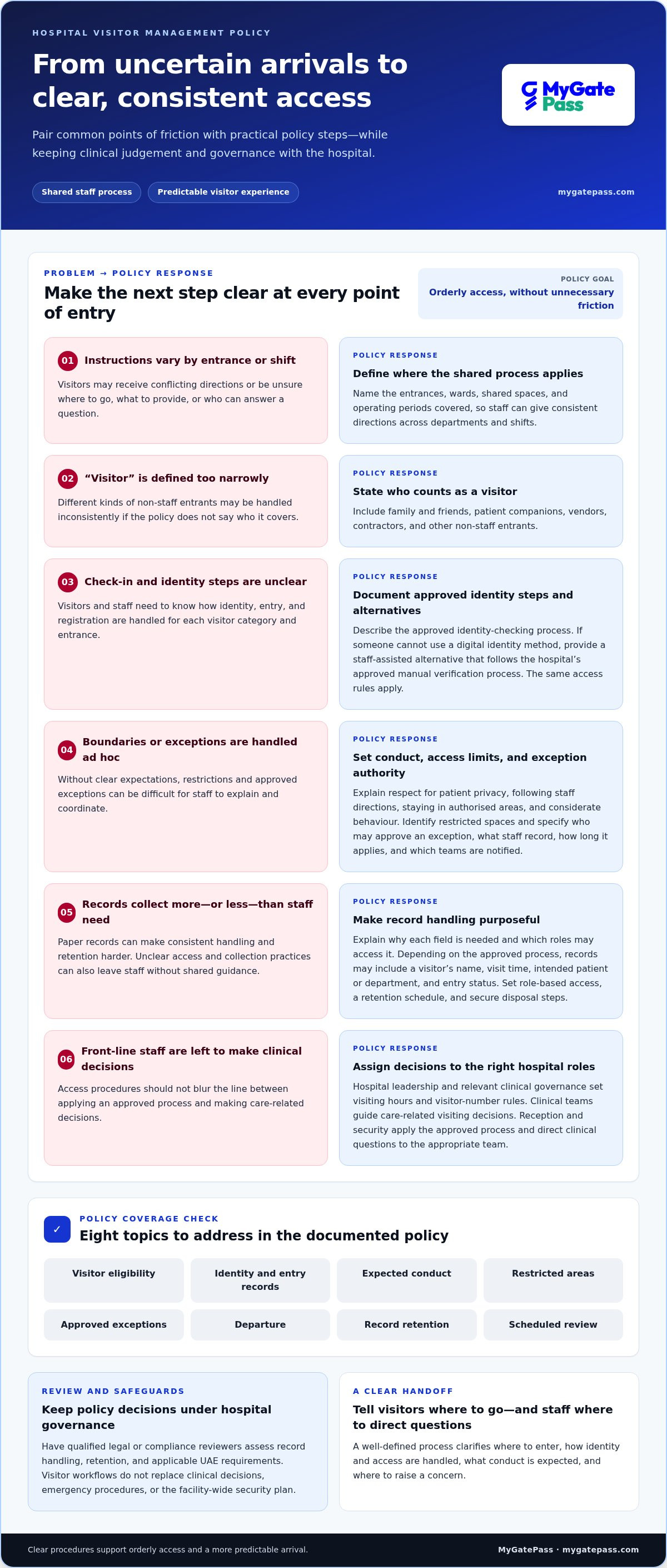
Define “visitor” broadly enough to cover everyone who is not a member of staff, including family and friends, patient companions, vendors, contractors, and other non-staff entrants. Then state where and when the policy applies: identify the entrances, wards, shared spaces, and operating periods covered by the standard process. This helps staff give consistent directions across departments and shifts.
Some circumstances may call for an approved exception. Specify who can authorise one, what information staff should record, how long the exception applies, and which teams need to know. A clear handover helps staff manage the exception without changing the ordinary process for other visitors.
Balancing patient needs with orderly access
Make dignity, privacy, rest, and clear communication central to the policy. Explain visiting expectations in language visitors can understand, and make the arrival process considerate for people who may be worried or unfamiliar with the hospital. Clinical teams should guide care-related visiting decisions under hospital policy. Reception and security staff can apply the approved process and direct clinical questions to the appropriate team.
Visitor arrangements also sit within a wider building-access context. The UAE Pass integration and building security guide offers broader context on identity-related workflows and building security. Hospitals should assess applicable UAE privacy and healthcare requirements with qualified legal or compliance reviewers, while keeping policy governance with the hospital.
A useful policy makes the next step clear for visitors and staff: where to enter, how identity and access are handled, what conduct is expected, and where to raise a concern. Clear directions support orderly access without making patient care secondary.
What a hospital visitor management policy should include
A useful policy turns broad expectations into steps staff can follow consistently. Cover visitor eligibility, identification, check-in, conduct, access limits, exceptions, departure, record handling, and scheduled review. Assign an owner to each decision and make the current approved version easy for staff to find, so guidance does not vary between departments or shifts.
Checklist sentence: Every hospital visitor management policy should address who may visit, how identity and entry are recorded, expected conduct, restricted areas, approved exceptions, departure, record retention, and review.
Set visiting hours and visitor-number rules through hospital leadership and relevant clinical governance. Document the rationale and name the role authorised to approve a change when patient needs or operational circumstances call for flexibility. Clear authority helps front-line teams explain a decision without making clinical judgements at reception.
Visitor identification, registration, and records
Describe the approved identity-checking steps for each visitor category and entrance. If a visitor cannot use a digital identity method, provide a staff-assisted alternative that follows the hospital’s approved manual verification process. Make clear that the same access rules apply, without assuming every visitor has a smartphone or can complete a digital check-in.
Keep records purposeful. For each field, explain why it is needed and which roles may access it. Depending on the hospital’s approved process, this may include a visitor’s name, visit time, intended patient or department, and entry status. Avoid collecting information simply because a system can capture it. Set role-based access expectations, a retention schedule, and secure disposal steps. Have qualified UAE legal or compliance advisers review lawful processing, retention, and applicable requirements before adoption.
Conduct, restricted access, and policy exceptions
Use plain language to explain expectations: respect patient privacy, follow staff directions, stay in authorised areas, and behave considerately toward patients and workers. Identify spaces visitors may not enter without approval, and explain how staff should respond if someone attempts to access a restricted area. A consistent, respectful explanation makes boundaries easier to understand.
Define who can approve an exception, what staff must record, and how relevant teams are notified. Subject to the hospital’s privacy rules, a record might capture the approving role, reason, scope, and review point. For sensitive situations, direct staff to hospital-approved escalation and patient-care procedures rather than asking reception teams to resolve clinical concerns themselves.
Specify how visitors check out or how staff otherwise close the visit record, who reviews policy performance, and how updates are communicated. Hospitals can use MyGatePass visitor management to support digital visitor workflows; policy decisions and governance remain with hospital leadership.
Manual or digital visitor management: compare the workflows
Choosing a visitor process is not simply a paper-versus-software decision. Hospitals need a workflow staff can follow across entrances and shifts, visitors can access, and administrators can govern. Compare options against the same practical criteria before deciding whether to retain a manual process, introduce digital tools, or combine the two.
Where manual processes work and where they strain
Paper logs are familiar and straightforward, but their usefulness depends on legible entries, consistent completion, and controlled storage. Spreadsheets can bring information together in one file, but they need clear permissions, careful updates, and a process for managing copies and versions. Neither format is automatically unsuitable or compliant. The hospital’s procedures and safeguards determine how well it works in practice.
| Workflow | Consistency | Visibility | Accessibility | Administration |
|---|---|---|---|---|
| Paper log | Depends on staff completing fields consistently | Entries are reviewed from the physical record | Available where the log is kept | Requires filing, storage, and retention routines |
| Spreadsheet | Uses shared fields, but upkeep is manual | Can gather entries in one file | Depends on permissions and access to the file | Requires updates, access management, and version control |
| Digital workflow | Can support a shared process across participating staff | May provide a central operational view | Depends on the chosen workflow and visitor access needs | Requires system governance and defined record practices |
How digital workflows can support policy execution
Digital tools can put the hospital’s approved rules into practice. A visitor app can support registration, while a security app can support staff-facing workflows. An administrative dashboard can provide an oversight point for connected visitor and security processes. These tools support implementation; they do not set visiting hours, determine clinical exceptions, or replace hospital governance.
Digital records still need careful oversight. Define who can access information, what data is collected and why, how long records are retained, and how they are securely disposed of. Review these arrangements with qualified UAE legal or compliance advisers. A digital format does not, by itself, guarantee privacy, security, or compliance.
Identity workflows also need to suit the people using them. Hospitals can evaluate UAE Pass integration against their policy, identity-checking needs, and visitor accessibility. Include a staff-assisted alternative for people unable to use digital identification.
For a practical look at digital entry approaches in the local context, explore digital gate pass approaches in the UAE. The right workflow makes approved procedures easier to apply while keeping record handling accountable.
How to create, introduce, and review the policy
A workable policy needs clear ownership, input from the teams who apply it, and a review process that keeps procedures relevant. Treat development as a cycle: agree on the rules, test how they work at the entrance, learn from their use, then update instructions where needed.
Assign owners and prepare the operating procedure
Name an accountable policy owner and involve clinical leadership, privacy or compliance roles, facilities, reception, and security teams in drafting. Each team sees different pressure points, from patient-care needs to entry flow and record handling. Their input helps turn policy decisions into practical instructions without shifting clinical authority to front-line entry staff.
- Set ownership and scope. Confirm who approves the policy, who maintains it, and which teams carry out each part. Define how proposed changes reach the decision-maker.
- Map the visitor journey. Document the steps from arrival through registration, any required approval, entry, exception handling, and departure. Include handoffs between reception, security, and the relevant department.
- Write role-based instructions. Explain what each staff role does, what it records, and where to direct questions it cannot resolve. Keep instructions accessible at the point of use.
- Prepare visitor-facing information. Describe entry requirements in plain language, including where to go and what to expect. Provide a clear way to explain the process to visitors who need assistance.
- Pilot at a suitable entrance. Test the draft workflow in a controlled setting before wider introduction. Observe where staff need clarification and where visitors encounter uncertainty, then adjust the operating procedure.
- Train and introduce the process. Brief relevant teams before launch, share the current approved version, and explain how staff can raise issues or request clarification.
Train teams and keep the policy current
Use realistic scenarios in training: a routine arrival, an approved exception, a visitor who needs an alternative to a digital step, and a concern that requires escalation. After the pilot and introduction, gather staff feedback and visitor comments through suitable channels. Record recurring issues so the policy owner can distinguish a training gap from a procedure that needs revision.
Set a scheduled review and bring it forward after a material operational, legal, privacy, or technology change. For UAE requirements, have qualified legal or compliance advisers assess what applies to the hospital and its records. Check that staff instructions, visitor explanations, and supporting digital workflows still match the approved policy.
Review principle: Track process consistency and concerns, not just registration volume. Visit counts alone do not show whether instructions are understood, exceptions are handled appropriately, or visitors experience avoidable friction.
To support consistent digital visitor and staff workflows as the hospital puts approved procedures into practice, explore MyGatePass visitor management solutions.
Support a consistent hospital visitor policy with connected workflows
Once hospital leadership has approved the rules, software can help teams put them into practice across visitor-facing and staff-facing processes. It can make an agreed workflow easier to follow, but it cannot set hospital policy, replace clinical judgement, or decide who should visit a patient. Keep those responsibilities with the hospital.
Connected workflows can link visitor registration, security-team processes, and administrative oversight. The goal is practical consistency: staff understand their part, administrators can oversee the process, and visitors receive clear directions. Digital tools should support the approved procedure, not dictate it.
Match software workflows to the approved policy
Map each approved policy step to a task. Identify what a visitor completes during registration, what staff need to do before directing someone onward, and who handles a question that needs escalation. Define staff permissions and administrative responsibilities before configuring a workflow, so access to information and decision-making follow hospital-approved roles.
Plan an accessible alternative for visitors who cannot complete a digital step. A staff-assisted route can preserve the same policy requirements without making a device or digital identity method the only way to proceed. Keep the visitor experience straightforward and tell staff when to use the alternative.
Plan a practical next step with MyGatePass
Start with one clearly defined visitor process and name its policy owner. Review the intended workflow with the relevant hospital teams, including privacy or compliance roles, reception, facilities, and security. This gives the hospital an opportunity to consider responsibilities, privacy questions, and visitor accessibility before extending the approach to other processes.
MyGatePass offers the MyGatePass Visitor App, MyGatePass Security App, MyGatePass Admin Dashboard, and UAE Pass Integration Module. These support connected visitor, security, administrative, and identity-related workflows. Their role is operational: the hospital remains responsible for its policy, clinical decisions, governance, and review of applicable requirements.
- Choose the process. Define its start and end points, such as visitor registration through departure.
- Assign ownership. Identify the hospital policy owner and the staff roles involved at each step.
- Review requirements. Discuss access permissions, information handling, privacy considerations, and escalation responsibilities with the appropriate hospital teams.
- Test the workflow. Walk through routine and exception scenarios, including the staff-assisted alternative for visitors who cannot complete a digital step.
- Assess and refine. Gather feedback from staff and visitors, then adjust the workflow to align with the approved policy.
For hospitals exploring a digital workflow that supports their approved rules, explore MyGatePass visitor management solutions. A focused starting point makes the process easier to evaluate while keeping policy ownership with the hospital.
Make your next step a focused one
A policy becomes more useful when teams apply it in a real visitor journey, learn from the experience, and refine the process. Choose one entry workflow to examine, then bring its policy owner and relevant staff together to consider how a digital approach could support their responsibilities. Keep hospital governance and clinical judgement at the centre of every decision.
MyGatePass brings together dedicated visitor and security applications, a centralised administrative dashboard, and a UAE Pass Integration Module for identity-related workflows. These tools support operational workflows around a hospital-approved policy, with requirements and use assessed by the hospital.
Explore MyGatePass visitor management solutions to consider how a digital workflow could support your hospital visitor management policy. Clear processes can make entry easier to navigate while keeping patient wellbeing in focus.
Frequently Asked Questions
What should a hospital visitor management policy include?
A hospital visitor management policy should give staff clear instructions for routine visits and less common situations. Alongside visitor eligibility, entry, conduct, exceptions, and departure, specify how staff respond if a visitor arrives at the wrong entrance, cannot provide the requested patient details, or needs help understanding instructions. Assign responsibility for resolving each issue so staff can route questions without sharing unnecessary patient information.
Can hospitals require visitors to show identification?
Hospitals can set identity-checking steps within their visitor procedures, but the approach should be reviewed against applicable requirements and the hospital’s needs. Explain which forms of identification are accepted, how staff handle a visitor without them, and when to escalate an unresolved identity question. For example, a companion who cannot complete a digital check should have a clear staff-assisted route rather than being left unsure how to proceed.
How should hospitals protect visitor registration data?
Collect only information needed for a defined visitor-management purpose, and make access and handling responsibilities clear. Reception staff may need information to process entry, while other roles may need access only for an assigned operational reason. Set procedures for correcting inaccurate entries, responding to access requests, and disposing of records at the end of the approved retention period. Have qualified UAE advisers review applicable privacy requirements.
Should hospitals use UAE Pass for visitor check-in?
UAE Pass can be considered as an identity-related option, but it should fit the hospital’s approved process rather than become the only route by default. Assess how it aligns with visitor needs, staff procedures, and the identity checks the hospital has chosen. Keep an alternative for visitors who cannot use it, and review related data handling and deployment details with the hospital’s privacy or compliance team.
How can hospitals manage visitor exceptions without weakening security?
Use a defined approval path rather than informal, undocumented workarounds. For example, refer an exception request to the role authorised under hospital policy, then record the decision and its scope using the approved process. Give the visitor clear directions about what is permitted, and brief relevant staff on the outcome. Clinical or urgent care concerns should follow the hospital’s established escalation procedures.
How often should a hospital visitor management policy be reviewed?
Set a recurring review schedule approved by hospital leadership, then bring the review forward if operations, applicable requirements, privacy arrangements, or supporting technology change. Also consider reviewing after recurring staff questions, visitor complaints, or an access-related incident, since these may reveal unclear instructions. Record the review date, issues considered, decisions made, and owner of any follow-up, so updates can be tracked and communicated consistently.


