

Could the front desk be creating more work than it appears to? To learn how to write a business case for VMS, start with entry challenges you can observe: queues, repeated data entry, incomplete records, or time spent finding visitor information.
Manual processes can be difficult to assess consistently, and a promise of convenience alone is rarely enough to secure approval. A credible case connects the current workflow to operational value using evidence stakeholders can review. Because VMS can refer to different systems, define it as a visitor management system in your proposal.
This guide explains how to document the current process, choose practical measures such as staff time and record completeness, and compare existing workflows with digital options. It also covers how to assess security, visitor experience, and visitor data handling in a UAE context without overstating what a system can deliver. The goal is a clear, evidence-led case with a practical next step.
Key Takeaways
- Learn how to write a business case for VMS by linking specific entry-process issues to outcomes decision-makers can assess.
- Build a reliable baseline from existing records and observations, tracing each step from visitor arrival to record-keeping.
- Compare manual and digital workflows against consistent criteria, including registration, visitor history, and administrative visibility.
- Shape your recommendation around the needs of facility managers, property owners, security teams, and budget approvers.
- Map MyGatePass features to needs identified in your assessment, and describe expected results as objectives rather than guarantees.
What Does VMS Mean in a Visitor Management Business Case?
A visitor management system (VMS) is software for registering visitors, recording their visits, and managing their entry to a workplace or facility. It puts the entry process into a structured digital workflow instead of relying only on paper logs or scattered records. For a foundational overview of the Visitor Management System category, see its general description and purpose.
“VMS” isn’t used consistently across business software. Define the term in your proposal so stakeholders understand that the investment concerns visitor entry, not another type of system.
Visitor management system versus vendor management system
This article uses VMS to mean visitor management system. It concerns people entering a building: how they arrive, register, complete any required identity checks, gain entry, and have their visit recorded. A vendor management system, by contrast, commonly supports supplier or contingent-worker administration, such as coordinating workforce arrangements and related processes. The acronyms overlap, but the workflows are different.
Spell out “visitor management system” the first time it appears in a business case, presentation, or funding request. If stakeholders use VMS differently, define the abbreviation in the title or executive summary too. This simple step keeps facilities, security, procurement, and finance teams focused on the same proposed change.
What a visitor-management business case should prove
A business case should connect a documented operational challenge to a proposed response, then explain how decision-makers can judge whether that response is worthwhile. For a facility in the UAE, describe the setting in practical terms, including the type of site, visitor groups, entry points, and teams involved. Ground the case in your organization’s workflow and records rather than broad claims.
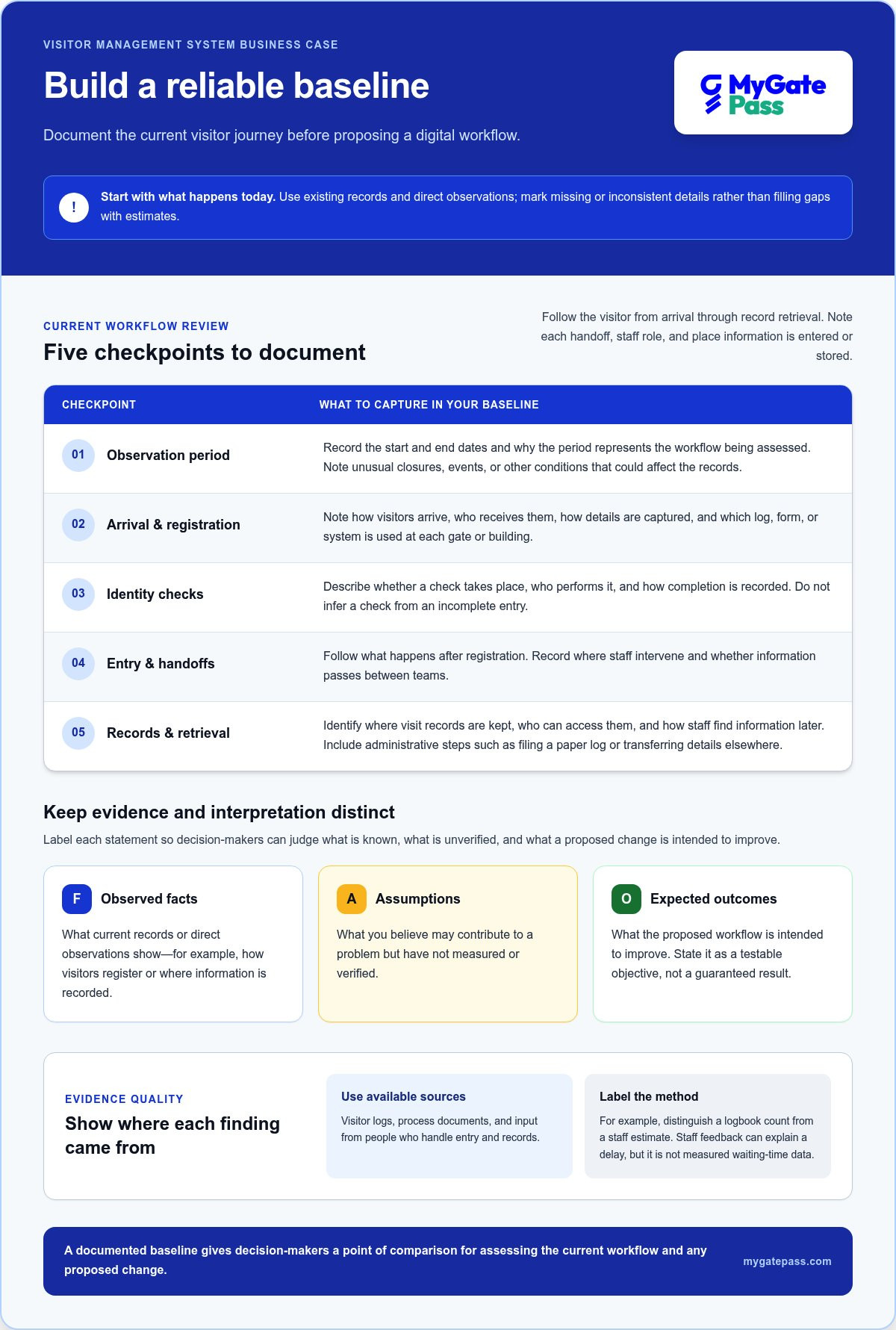
To understand how to write a business case for VMS, keep three kinds of statements separate:
- Observed facts: What current records or direct observations show, such as how visitors register or where information is recorded.
- Assumptions: What you believe may contribute to a problem but haven’t measured or verified.
- Expected outcomes: What a proposed digital workflow is intended to improve, stated as a testable objective rather than a guaranteed result.
For example, if visitor details are written in a logbook and later re-entered elsewhere, describe that as an observed workflow only if it reflects what happens at your site. Treat any projected time saving as an estimate until it’s tested against a baseline.
State your decision criteria before recommending a solution. They might include capturing visitor records digitally, giving relevant teams access to useful information, or supporting entry across multiple buildings. The aim isn’t to claim software will solve every issue. It’s to make the need, expected value, and basis for comparing options clear.
Build a Reliable Baseline for Your Visitor Management System Case
A useful baseline shows how visitor entry works before you propose software. Start with your organization’s existing records and processes, then describe what they capture and where they leave gaps. Include the relevant buildings, gates, visitor types, and teams so decision-makers can understand the assessment’s scope.
Map the current visitor journey and administrative workload
Follow a visitor from arrival until the visit is recorded. Note each handoff, the staff involved, and where information is entered, stored, or retrieved. Include administrative steps after entry, such as filing a paper log or transferring details to another record. Mapping these steps makes hidden effort and process gaps easier to discuss.
Use a consistent sequence to document the baseline:
- Set the observation period. State its start and end dates, and explain why it represents the workflow you’re assessing. Note unusual closures, events, or other conditions that may affect the records.
- Trace arrival and registration. Record how visitors arrive, who receives them, and how their details are captured. Identify the log, form, or system used at each gate or building.
- Document identity checks. Describe whether a check takes place, who performs it, and how its completion is recorded. Don’t infer a check from an incomplete entry.
- Follow entry and handoffs. Note how visitors proceed after registration, where staff intervene, and whether information passes between teams.
- Check record-keeping and retrieval. Identify where visit records are kept, who can access them, and how staff find information later. Mark missing or inconsistent fields rather than filling gaps with estimates.
If you measure waiting time or staff effort, record the method and distinguish direct observations from figures already available in records. Staff feedback can help explain a delay, but label it as feedback rather than measured waiting-time data.
A credible baseline gives decision-makers a documented point of comparison for assessing the current workflow and any proposed change.
Choose evidence decision-makers can review
Bring together available visitor logs, process documents, and input from the people who handle entry and records. Note the source beside each finding. For instance, identify whether a count came from a logbook review or a staff estimate. This helps readers judge the strength of the evidence.
Compare gates or buildings only when the records support a fair comparison. Use the same definitions and observation period where possible. If one location records arrivals differently, explain that limitation instead of presenting the figures as directly equivalent. In how to write a business case for VMS, transparency about what you couldn’t measure is as valuable as a clear finding.
Once the baseline is organised, use it to assess whether digital visitor records and centralized visibility address documented needs. Explore how MyGatePass visitor management fits those workflow requirements.
Compare Visitor Management Options Without Overstating ROI
Use the baseline to compare three paths: keep the existing process, introduce a digital visitor workflow, or assess specific visitor-management software options. Apply the same criteria to each. This keeps the discussion focused on operational fit instead of a feature list, and helps decision-makers distinguish evidence from proposals and unresolved questions.
Compare operational fit, security, and visitor experience
Assess how each option handles registration, visitor records, staff-facing tasks, and information retrieval. If several gates or buildings are involved, consider whether administrators need a centralized view of registration activity. Also consider the visitor’s experience: where they may need to wait, repeat information, or ask for help. Describe the current process using your baseline, then compare it with stated capabilities rather than assuming all digital options work the same way.
MyGatePass supports digital visitor records and QR-based entry. Its Administrative Dashboard centralizes real-time visitor registration data across multiple gates or buildings, and UAE Pass integration supports verified visitor identification. Compare these capabilities with your organization’s requirements; they don’t by themselves prove a particular time saving or security outcome.
Use the table to give reviewers a consistent view. Fill in the evidence and open-question columns using your own records and evaluation.
| Criteria | Current evidence | Proposed capability | Assumptions | Open questions |
|---|---|---|---|---|
| Visitor registration | Current forms, logs, or observed handoffs | Digital registration or QR-based entry | Visitors and staff can use the proposed steps | Which visitor groups and gates are in scope? |
| Visitor history | Where records are stored and how they’re retrieved | Digital visitor records and history | Records capture the details the organization needs | Which records should be available, and to whom? |
| Administrative visibility | How managers currently view registration activity | Centralized real-time registration data, where relevant | Relevant teams need a shared view | Which buildings or gates need to be included? |
| Identity checks | Existing check steps and documentation | UAE Pass integration for verified visitor identification | The integration fits the intended visitor process | How should this step fit into the workflow? |
Calculate value transparently and show assumptions
In how to write a business case for VMS, separate measured benefits from projections. Use organization-specific inputs, such as observed staff time spent on a documented task, and show how you calculated the result. Label estimates as assumptions, explain how to test them, and don’t present projected efficiency as guaranteed savings.
Include implementation or ongoing costs only when you have reliable figures, and present monetary amounts in AED. A data-breach-cost benchmark can provide wider context, but it isn’t a forecast of savings from visitor-management software. If you cite one, identify its source, date, and definition. Don’t use it to claim that a system will prevent a breach or deliver a specific return.
As you refine the criteria, consider MyGatePass visitor-management capabilities alongside the workflow needs your comparison identifies.
How to Structure and Present a Visitor Management Business Case
A strong case is easy to scan and easy to review. Give readers a clear route from the operational need to the decision you’re requesting, and support each claim with evidence from your assessment. Tailor the details to the facility, the people involved, and how visitor entry works there.
Structure the business case in this order: executive summary, baseline, objectives, options, evidence, risks, and requested decision. Keep the same sequence throughout so reviewers can follow the logic without searching for key details.
- Executive summary: State the visitor-management challenge, proposed direction, strongest supporting evidence, and decision required.
- Baseline: Summarize the current workflow and its documented limitations, including the assessment scope and evidence sources.
- Objectives: Define what the organization wants to improve, such as how visitor records are captured or made visible to relevant teams.
- Options: Compare retaining the current approach with a digital workflow and relevant software options against consistent criteria.
- Evidence: Show the observations, records, assumptions, and calculations that support the comparison.
- Risks: Identify issues that may affect data handling, adoption, or continuity of entry operations.
- Requested decision: Specify the approval or next evaluation step, along with who owns it.
Turn evidence into a clear executive summary
Write the summary after completing the detailed case, even though it appears first. This helps keep it aligned with the evidence and assumptions. A facility manager may need to understand workflow implications; a property owner may focus on consistency across buildings; security teams may want clear records and responsibilities; budget approvers need a transparent basis for the requested decision.
Market growth can provide background, but it can’t prove that one organization will achieve a particular result. The $3.0 B VMS market projection by 2028 is broad market context, not site-specific evidence. Identify its source, publication date, and definition if you include it.
Address risks, ownership, and approval criteria
Name who will validate baseline information, assess the proposed workflow, and review the evidence. Depending on the organization, responsibilities may involve facilities, security, IT, privacy, procurement, or finance. Clear ownership helps prevent a proposal from stalling because no one knows who should resolve an open question.
Agree on approval criteria before presenting expected benefits. These could include operational fit, how records are managed, administrator visibility, and the organization’s ability to support the workflow. Treat data handling, staff adoption, and continuity during a process change as review topics, not assumed strengths or weaknesses. For how to write a business case for VMS, being clear about risks is part of making a credible recommendation.
Ready to connect your evaluation criteria to a visitor-management workflow? Explore MyGatePass visitor management as you shape the options for your case.
Where MyGatePass Fits in a Visitor Management Business Case
Include a platform in your business case where its capabilities match needs established by your baseline. Use the criteria you’ve already set, such as registration steps, record access, and visibility across buildings. Then describe the fit plainly: what the platform supports, which documented need it relates to, and how it fits your proposed workflow.
Match MyGatePass features to documented requirements
If your review identifies a need for digital registration or QR-based entry, compare those capabilities with the current process. MyGatePass supports digital visitor records, QR-based entry, and Visitor History, a digital record of visitor activity. Relate these features to your record-keeping requirements, without assuming they will deliver a particular time saving or operational result.
For facilities where administrators need a shared view of visitor activity, the MyGatePass Administrative Dashboard centralizes real-time visitor registration data across multiple gates or buildings. Connected Network supports integration across participating buildings for smoother access. Compare these features with your site structure and the teams that need access to visitor information.
UAE Pass integration supports verified visitor identification. Include it in your comparison if verified identity is a documented requirement, and assess how it fits the intended visitor journey. The UAE Pass integration guide offers related context. For an overview of digital gate pass apps, see the digital gate pass apps guide.
MyGatePass has processed 150 k+ visitor entries, and 20 % of entries are QR pre-registered. Use these figures as platform context, not as forecasts for your facility or proof of a specific return.
Set a practical next step after internal review
As you apply how to write a business case for VMS to your decision, keep a concise record of baseline evidence, assumptions, stakeholders, and approval criteria. Make clear which capabilities address each documented need, which questions remain open, and who will assess them. That keeps the recommendation grounded in your organization’s entry process.
Compare the proposed workflow with the current one using the same criteria, then share the results with the people responsible for facilities, security, data review, and budget approval. Focus on fit and evidence rather than promised savings. If MyGatePass aligns with your requirements, get started with MyGatePass as you continue your evaluation.
Turn Your Recommendation into a Measurable Next Step
A business case shouldn’t end at approval. Use the decision to set a clear starting point for evaluation: who owns the next step, which objectives matter most, and how the organization will review progress. This keeps expectations grounded and gives teams a shared way to assess whether the proposed visitor workflow fits actual operations.
As you apply how to write a business case for VMS, keep evidence and expectation distinct. A practical case doesn’t need to promise a perfect outcome. It needs to make the need understandable, the decision criteria fair, and the next action clear.
If MyGatePass aligns with your team’s requirements, register today and get started with MyGatePass to take the next step toward a more considered visitor-management process.
Frequently Asked Questions
How long does it take to write a business case for a visitor management system?
There’s no fixed timeline. Preparation depends on how quickly you can access visitor records, process information, stakeholder input, and reliable cost details. Start with what’s available, then note gaps that need follow-up rather than waiting until every detail is complete. For example, draft the operational need while a budget owner validates financial inputs, then update the case before requesting a decision.
Can I write a visitor management system business case without a confirmed budget?
Yes. You can make the case for evaluating a change before a final budget is approved. Document the operational issue, available evidence, desired outcomes, and criteria for comparing options. Mark unknown costs as pending, and don’t present unsupported estimates as facts. This gives approvers a clear view of the decision they can make now, such as authorising further evaluation, and the financial information needed before a purchase decision.
Who should be involved in reviewing a visitor management system business case?
Include people who understand visitor entry, facility operations, security processes, and spending decisions. Operational staff can explain how tasks work in practice, while budget approvers consider priorities and resources. Involve technology or privacy reviewers if the proposed workflow raises questions within their remit. Ask each reviewer to examine assumptions tied to their area so gaps and conflicting expectations surface before final approval.
Is a visitor management business case useful for a single building?
Yes. A single building can have entry challenges that justify comparing the current process with a proposed change. Keep the assessment proportionate to the site: use its own visitor records, staff input, and workflow rather than borrowing assumptions from a larger property portfolio. If future expansion is being discussed, label it as a possibility for later review, not a confirmed outcome or a reason to overstate today’s case.
What should an executive summary for a VMS business case include?
Keep it focused on the decision. State the visitor-management issue, the strongest supporting evidence, the direction being considered, key assumptions, and the approval requested. If you're deciding how to write a business case for VMS, define the acronym as “visitor management system” in the summary so readers share the same understanding. Check that each claim is supported in the main document and that the summary introduces no new promises.
How often should an approved visitor management business case be reviewed?
Choose a review point that fits your organization’s planning and operational cycles. Revisit the case when a meaningful change could affect its original assumptions, such as a revised entry process, a change in building use, or new decision criteria. Compare available evidence with the approved objectives, and record why any assumptions or priorities have changed. Set the review schedule around your organization’s needs rather than a universal timetable.
Can a visitor management system business case include benefits that are not financial?
Yes. A business case can include operational or visitor-experience benefits alongside financial considerations. Define each benefit clearly and explain how you’ll assess it. For instance, a team might gather structured feedback on whether visitors understand the registration steps, while staff document recurring process questions. Keep these measures distinct from financial calculations, and describe intended benefits as objectives until your organization has evidence that they’ve been achieved.


