

Building delivery management starts at the entry point, not on the road. For UAE properties, choosing delivery management software means understanding how a delivery is handled once it reaches the building, not just how a vehicle gets to the address. Dispatch tools coordinate fleet movement; a building workflow focuses on the people, procedures and handoffs at the property.
When deliveries arrive while staff are handling other entry tasks, instructions can end up scattered across calls, messages or paper logs. A clear process helps staff know who handles the arrival, who receives the delivery and where responsibility changes hands. Start by identifying that operational gap, then choose software for the job it needs to support.
This guide explains how to map a delivery workflow, distinguish building-entry needs from fleet dispatch and compare software against practical criteria. MyGatePass offers a Delivery Management System within its visitor and facility management ecosystem, alongside visitor and security apps, an Admin Dashboard and UAE Pass integration. The guide also explains how to assess delivery needs separately from visitor registration and other building processes.
Key Takeaways
- Define the building-level delivery problem before choosing software, so the process addresses a real handoff or coordination need.
- Map delivery coordination, building entry and fleet or order management as distinct stages, then identify where information must pass between them.
- Compare delivery management software Dubai options against your building’s workflow, not just a broad feature list.
- Document current handoffs and involve the people who manage deliveries, entry and facility operations before deciding what to digitise.
- MyGatePass’s Delivery Management System sits within a connected building software ecosystem that also includes visitor and security apps, an Admin Dashboard and UAE Pass integration.
What delivery management software means for UAE building operations
Delivery management means different things to a logistics team and a building operator. A fleet team may focus on vehicles, routes and dispatch. A facility team focuses on what happens when a delivery reaches the property: how the arrival is handled, who needs to be involved and where the building-side handoff ends. Separating these needs helps teams choose software for the right operational problem.
Building delivery management software supports the coordination of delivery activity at a property’s entry and handoff points. It is distinct from software that dispatches vehicles or manages last-mile logistics. Broader Distribution software can cover logistics and inventory-related processes, while a building’s entry workflow involves its own people, procedures and access considerations.
Delivery activity intersects with shared spaces, staff responsibilities and entry procedures. A handoff may involve reception, security, a resident or employee, and the delivery person. Without a consistent process, staff may need to call or message to find out who should receive an item, while instructions and records remain in different places. Mapping these friction points helps the building decide what needs to change, rather than assuming every property needs the same solution.
Where building delivery workflows begin and end
For a building team, the workflow generally begins when a delivery arrives at the property and the relevant staff member or recipient is identified. It ends at the handoff point set by the property’s procedures, such as a person or designated area. Defining this boundary shows which steps belong to building operations and which sit elsewhere.
Road routing, vehicle assignment and dispatch belong to fleet or logistics operations. A building-entry process does not replace those systems, and dispatch software does not necessarily address what happens after a delivery reaches the property. When evaluating delivery management software Dubai teams may use, assess the building-side process separately from the journey to the door.
Who evaluates delivery management software in a building
Facility managers and property operators can define the building process. Security teams can explain how arrivals are handled at entry, while residents and staff can clarify how recipients are identified and reached. Delivery personnel can help reveal unclear instructions or handoff points. Involving these groups early helps pinpoint where responsibility changes hands and what information people need.
Use their input to create a process that is workable for everyone involved. For example, if staff are unsure who owns the next step when a delivery arrives, record that gap and agree on the intended responsibility before selecting software. The aim is to make the process easier to follow, not to add administration without a clear purpose.
- Facility managers: map the handoff and identify process gaps.
- Security teams: describe how arrivals are handled at the building entry.
- Residents and staff: clarify how recipients are identified and reached.
- Delivery personnel: help surface unclear instructions or handoff points.
Start with the building’s actual workflow. Once its boundaries and stakeholders are clear, you can decide whether the priority is entry coordination, fleet dispatch or a connection between separate processes.
How digital delivery workflows connect with building entry management
A digital workflow is easier to assess when each part has a clear boundary. Delivery coordination concerns the building-side handoff. Entry management concerns how people are handled at the property. Fleet or order-management systems deal with activity outside the building. These processes can exchange information without becoming one system.
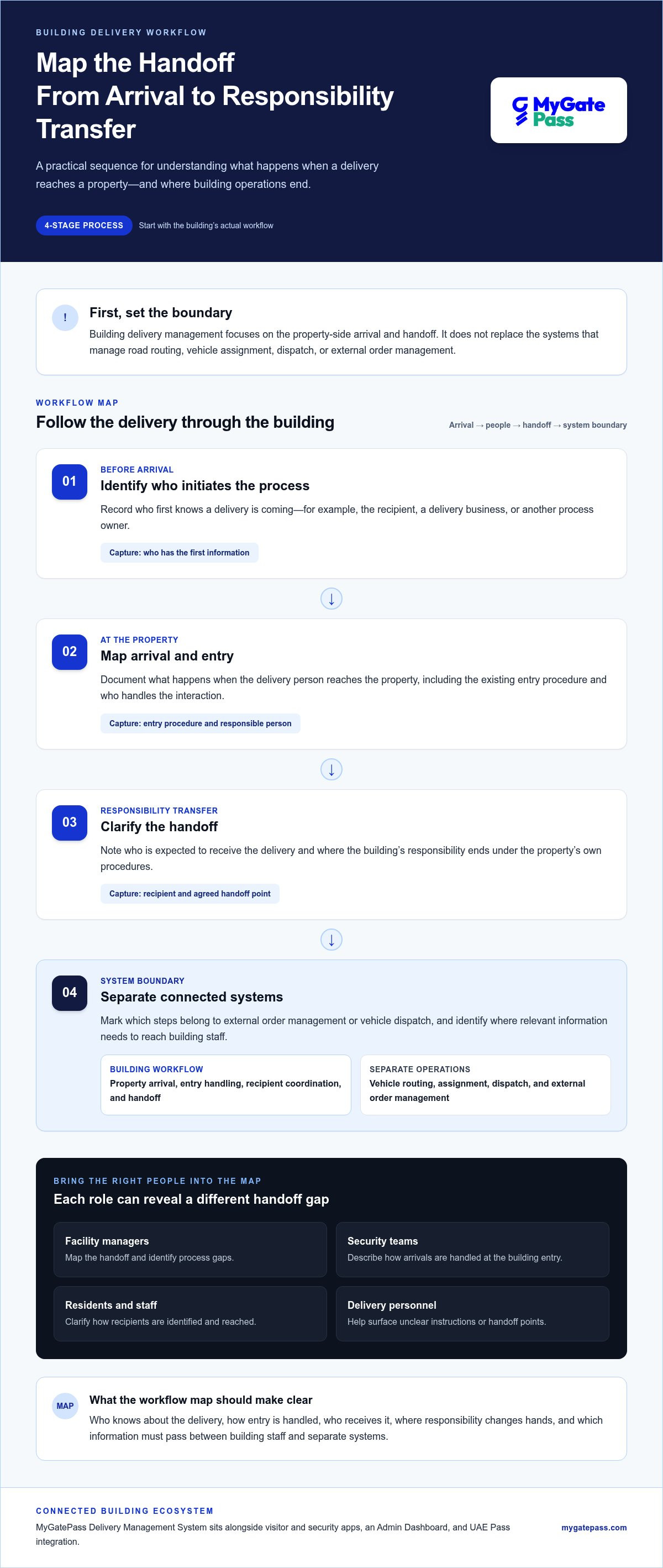
Use this sequence to map the current process and identify where information or responsibility moves from one person or system to another:
- Identify the initiating party. Record who first knows a delivery is coming, such as the recipient, a delivery business or another process owner.
- Map arrival and entry. Document what happens when the delivery person reaches the property, including the existing entry procedure and who handles the interaction.
- Clarify the handoff. Note who is expected to receive the delivery and where the building’s responsibility ends under its own procedures.
- Separate connected systems. Mark which steps belong to external order management or vehicle dispatch, and where information needs to reach building staff.
Map people, handoffs, and information
Facility managers, property operators and security teams can compare their understanding of each step. Residents or staff can explain how recipients are identified, while delivery personnel can point out where instructions are unclear. Record the information people actually use and mark each point where responsibility changes hands. Separate observed issues, such as an unclear handoff, from assumptions about what software should do.
This process helps teams assess delivery management software Dubai properties may consider without treating every familiar logistics feature as a building-entry capability. Route planning and dispatch can remain with fleet processes, while entry procedures remain a building responsibility.
Understand the role of building digital tools
MyGatePass’s Delivery Management System is part of its wider software suite for visitor and facility management. The suite also includes the MyGatePass Security App, MyGatePass Visitor App and MyGatePass Admin Dashboard. This connected context is useful when considering how delivery management fits alongside other building operations.
The platform includes Visitor History and Connected Network. These are platform features, distinct from delivery management. The Admin Dashboard provides centralized, real-time visitor registration data for multiple gates or buildings. This supports visibility into visitor registration and should not be confused with delivery reporting or parcel tracking.
Identity processes are another related but separate consideration. A building can assess identity workflows alongside its delivery process without treating them as the same requirement. The UAE Pass integration for buildings guide explores that topic.
Once the handoffs and information needs are documented, compare them with the role of each digital tool. To see how delivery management sits within MyGatePass’s wider building software, explore the MyGatePass platform.
Delivery management software versus fleet dispatch: compare the right scope
Software labels can overlap, but the operational jobs are different. A building operator may need to organise activity at an entry point, while a delivery business may manage orders and a fleet owner may coordinate vehicles. One category does not automatically replace the others. Compare tools against the steps your team needs to manage.
| Software scope | Primary focus | Typical requirement to assess |
|---|---|---|
| Building-entry coordination | Delivery activity at a property and the building-side handoff | How facility staff coordinate the process with entry procedures and relevant recipients |
| Fleet dispatch | Vehicle and driver operations | Whether dispatch, route planning or vehicle tracking is needed for journeys |
| Broader delivery operations | Order and last-mile processes across the delivery business | Whether customer, order or delivery-evidence requirements extend beyond the property |
These scopes can connect, but they answer different questions. A building may use an external dispatch process and still need to define its own entry workflow. A delivery business may need order management without managing building access, while a fleet owner may prioritise vehicle operations. The right combination depends on who owns each step and what information needs to pass between them.
When a building-focused delivery workflow is the priority
Focus on facility operations if the main challenge is coordinating the building-side process: who handles an arrival, how it relates to entry procedures and where staff responsibility ends. MyGatePass offers a Delivery Management System as part of its wider software ecosystem for managed buildings. Assess it in relation to the delivery process your building needs to manage.
MyGatePass also offers visitor and security tools, with visitor features distinct from delivery requirements. For example, visitor registration information is not delivery reporting. Keeping these categories clear helps teams select a scope that matches their documented process.
When fleet dispatch or last-mile tools are also relevant
Routing, vehicle tracking and delivery evidence are separate operational requirements. Fleetmanagement.ae’s positioning emphasises vehicle tracking and route optimisation, while shyphan.com presents custom last-mile delivery systems. These examples illustrate different software scopes, not a template for building operations.
Before selecting a system, list the workflow steps, the team responsible for each one and the information needed at handoffs. Then compare those needs with the software’s stated scope, rather than relying on a label such as “delivery platform.” This keeps the assessment practical, whether the priority is building entry, fleet dispatch or coordination between the two.
For properties focused on building operations, explore MyGatePass’s delivery management system as part of the broader facility software ecosystem.
How to prepare a building for delivery management software
A useful software evaluation starts with the process already in place. Before comparing delivery management software Dubai options, document how a delivery-related interaction moves through the building, who takes responsibility and what information people need at each handoff. This gives the team a practical basis for deciding what to digitise, instead of choosing features first and trying to fit the process around them.
Document current roles and delivery handoffs
Walk through the building-side workflow with the people who carry it out. Write down who is responsible at each point, from the arrival interaction to the handoff under the property’s procedures. Include the facility or property manager, security staff and any relevant reception, resident or employee roles. The goal is to record how the process works in practice, not to assume every building has the same arrangement.
Then note what information is captured, where it is kept and who needs it to carry out their role. Flag steps that rely on verbal instructions or leave staff unsure who owns the next action. These observations help separate an actual coordination issue from an assumption that software should solve it.
- Roles: Record who initiates, handles, receives and oversees each handoff.
- Information: Note what staff refer to and where that information currently sits.
- Responsibility: Mark any unclear transition between building staff, recipients and delivery personnel.
- Boundaries: Separate building-entry tasks from external order handling, fleet dispatch and road routing.
Set evaluation criteria and a realistic scope
Turn the process notes into a short set of priorities. Your team might need clearer coordination between staff, a defined point of oversight or a workflow that fits existing building entry procedures. Keep these needs separate from ways to review the process, such as whether responsibilities are assigned and staff can find the information they need. These checks help assess the workflow; they do not promise a particular software outcome.
Next, label each requirement as essential, useful or outside the building’s scope. Vehicle tracking, routing or delivery evidence may matter to a fleet or delivery business, but they are not automatically building-entry requirements. This distinction helps teams compare products by their role in the documented workflow, not just by feature labels. For related gate-management context, see this guide to digital gate pass apps in the UAE.
Once the checklist is clear, consider how MyGatePass’s Delivery Management System fits within a broader software ecosystem for managed buildings. Explore MyGatePass’s delivery management offering as a next step in evaluating your building process.
How MyGatePass fits delivery management into a connected building ecosystem
A building’s delivery process is one part of a wider operations picture. MyGatePass offers a Delivery Management System alongside visitor and security apps, an Administrative Dashboard and a UAE Pass Integration Module. Facility teams can consider the delivery system within this wider software ecosystem while keeping each operational need distinct.
What MyGatePass brings to building operations
MyGatePass supports smooth, secure gate entry across the UAE and GCC. Its connected suite includes the MyGatePass Visitor App, MyGatePass Security App and MyGatePass Admin Dashboard. The UAE Pass Integration Module is another part of the offering, relevant to identity workflows as a separate consideration from delivery coordination.
Platform features include Visitor History and Connected Network. These are capabilities within the wider platform, not delivery-specific functions. The Admin Dashboard provides centralized, real-time visitor registration data for multiple gates or buildings. That view supports operational visibility around visitor registration; it is not a delivery log or delivery activity report.
MyGatePass has processed 150 k+ visitor entries. This is a platform-level visitor-entry figure, not a measure of delivery activity. Keeping that distinction clear helps facility managers assess information in context and compare software against the process it is intended to support.
The Delivery Management System sits within this wider ecosystem for managed building operations. For teams evaluating delivery management software Dubai properties can use, the practical question is how delivery-related activity fits the building’s entry and facility processes. The suite’s visitor and security capabilities provide context, while the delivery system addresses a distinct part of the building’s software needs.
Explore a simpler approach to managed entry
Digital building workflows can give teams a clearer structure for responsibilities and information when the process is defined first. A thoughtful assessment separates delivery coordination from visitor registration, security workflows and external fleet operations. It also considers the people using the process: staff need steps they can follow, and visitors need entry that feels orderly and welcoming.
Security and convenience can work together when tools are assessed against real building needs and their roles are clear. MyGatePass brings delivery management into a broader facility software ecosystem, alongside visitor, security, dashboard and identity offerings.
Explore the MyGatePass platform to see how its software ecosystem can support your building’s approach to managed entry and delivery processes.
Take the next step toward a clearer delivery process
Start with one handoff that is difficult to manage. Bring the relevant team members together, agree who owns that step and write down what information they need to carry it out. A clearly defined starting point gives your team a practical way to assess a digital workflow without redesigning every building process at once.
Use the agreed process as your reference when evaluating delivery management software Dubai teams may consider. The right scope should reflect how your property operates and where a digital tool fits, not simply how many features appear on a product page. Keep the focus on a process people can understand and use.
MyGatePass brings delivery management into a broader building software ecosystem. Explore the platform and consider how its approach could fit your operational priorities. Unlock a world of simplicity. Register today and get started with MyGatePass.
A clearer process begins with one thoughtful step. Your team can build from there.
Frequently Asked Questions
What does delivery management software do for a building?
It supports a building team in organising the property-side steps involved in handling deliveries. For example, a facility manager can define who handles an arrival and who takes responsibility for the handoff. Before selecting a tool, identify the task causing difficulty. Building coordination is different from managing parcels, routes or delivery notifications, so assess each need on its own.
How is delivery management software different from dispatch software?
Delivery management software for a building focuses on property-side coordination, while dispatch software generally concerns assigning or coordinating delivery journeys. A delivery business may plan which driver handles a job, while a building team defines what happens when that driver arrives. This distinction matters because vehicle-operation features do not necessarily address a building’s entry procedures.
Can delivery management software replace a fleet management system?
Building-focused delivery management and fleet management serve different teams and operational needs. A fleet owner may need vehicle oversight or route planning, while a property operator may need to organise building-side responsibilities. If both workflows matter, document them separately and identify where information needs to pass between teams. This helps clarify whether one system meets the needs or separate tools are more appropriate.
What should a facility manager compare when choosing delivery management software?
Compare each option against the building’s defined workflow, including who uses it, what task it supports and where its responsibility ends. For delivery management software Dubai properties are assessing, distinguish building-entry needs from fleet or order-management requirements. Also consider whether the process is clear to the staff expected to follow it. A feature list is useful only when it maps to an operational need.
How can a building prepare for a digital delivery workflow?
Document the current process, including who handles each step, what information they rely on and where handoffs become unclear. Then agree on the intended scope and involve the people who will use or be affected by the workflow. For instance, a facility team can review its proposed process with security staff before deciding what to digitise. This avoids automating a process nobody has clearly defined.
Does MyGatePass offer a Delivery Management System?
Yes. MyGatePass offers a Delivery Management System as part of its software ecosystem for visitor and facility management. It sits alongside the MyGatePass Visitor App, MyGatePass Security App, MyGatePass Admin Dashboard and UAE Pass Integration Module. Consider the delivery system in relation to your building’s needs, separately from the platform’s visitor-registration capabilities.
Can visitor management software and delivery management software be part of one platform?
Yes. A software suite can include visitor-management tools and a delivery-management system while keeping their purposes distinct. MyGatePass brings visitor and security apps, an Admin Dashboard and a Delivery Management System into one wider ecosystem. The dashboard’s stated centralized, real-time data relates to visitor registration, not delivery activity. Understanding each offering’s role helps teams assess how the platform fits their building operations.


