

A visitor access audit must look beyond the entrance. A visitor access audit checklist should assess the route into the building, physical features, visitor processes and management practices, including how disabled staff and visitors can evacuate in an emergency. The findings reveal barriers that can affect access and day-to-day operations.
It’s easy to focus on the visitor desk or entry system, but the whole journey matters. A smooth arrival depends on what visitors encounter before reaching reception and how their visit is managed once they’re inside.
This guide explains what to assess, how to prioritise findings, and how to choose a checklist that fits your UAE venue and services. It also covers how digital visitor management can support a more consistent, transparent access process.
Key Takeaways
- Look beyond the entry point to spot barriers across the visitor journey and everyday site operations.
- Record each finding clearly so your team can distinguish immediate access concerns from longer-term improvements.
- Match checklist choices to your venue and the services it provides, rather than relying on a one-size-fits-all review.
- See how digital visitor processes can support a smoother, more consistent arrival experience.
Why Should a Business Have an Access Audit?
An access audit helps businesses find barriers that a routine site walkthrough might miss. It can uncover problems with the approach, entrance, visitor process or emergency arrangements, helping facility managers plan practical improvements. Businesses are advised to arrange an access audit every few years and after changes that affect how visitors move through the site.
Accessibility also matters when businesses create materials for visitors. Braille House states that reproduction of its accessible tourism materials is subject to the Copyright Act 1968, except for uses permitted under that Act. Treat those materials accordingly when using them to support visitors who are blind or have low vision.
Visitor records need a clear purpose, controlled access, secure handling and a defined retention schedule. Keep only information needed for the visit and related operational needs, then remove it when no longer required under the organisation’s applicable retention rules. In the UAE, handle visitor information with privacy and data protection in mind, including who can access records and how they are protected.
To audit access logs, define the review period and authorised users first. Compare entries with visit approvals, arrival and departure details, and site procedures. Flag patterns such as missing departures, duplicate entries or access outside an approved visit, then document the reason and follow-up. A visitor access audit checklist helps keep the review consistent.
Audit frequency depends on site changes, visitor activity and operational risk. Businesses are advised to review access every few years. The time required depends on venue size, services, records and audit scope, so set the schedule around these factors.
Use the findings in business planning by recording each barrier, the visitor journey it affects and the proposed response. Group actions by urgency, budget needs and renovation timing. For example, a confusing arrival route may need clearer directions, while a planned refurbishment can be an opportunity to address physical barriers. This turns observations into trackable decisions.
Assessment categories for access elements
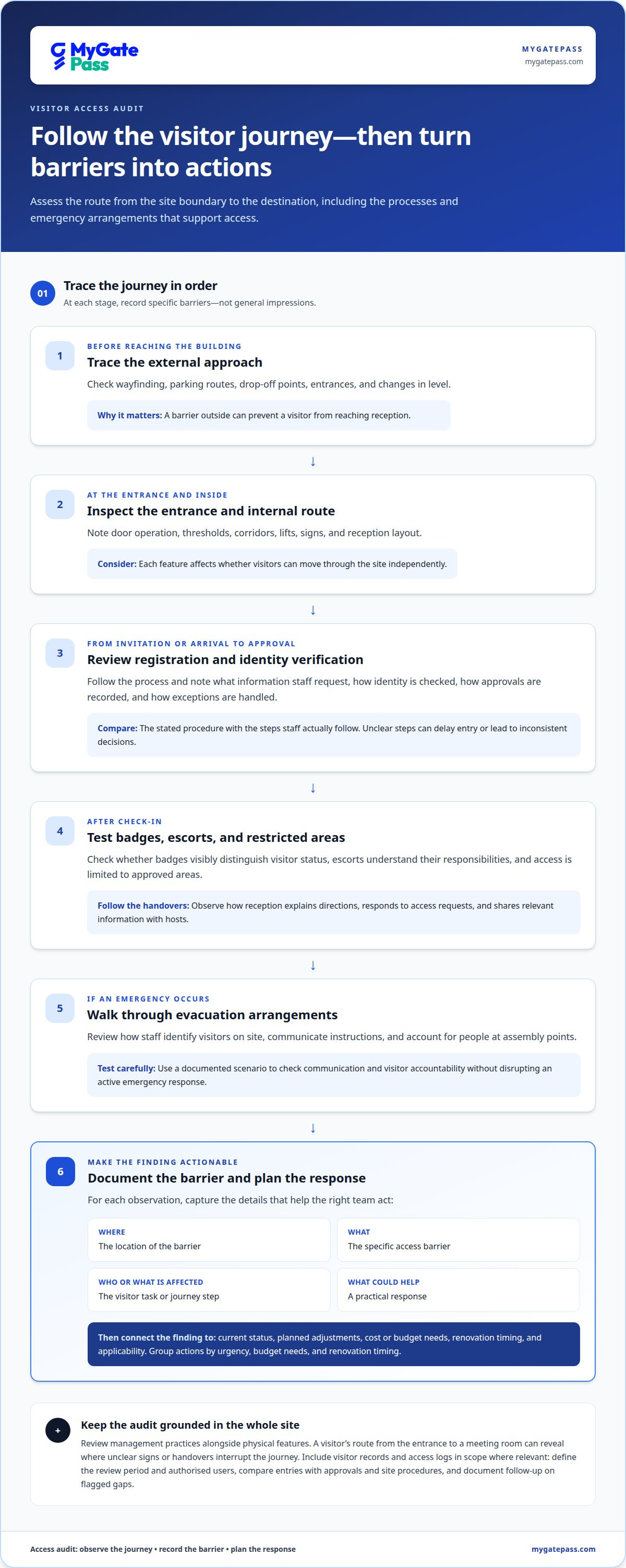
Assess the visitor journey from the site boundary to the destination, then review the management practices supporting each step. An access audit covers external areas and approaches as well as the building’s physical features. Record specific barriers rather than general impressions.
- Trace the external approach. Check wayfinding, parking routes, drop-off points, entrances, and changes in level because a barrier outside can prevent visitors reaching reception.
- Inspect the entrance and internal route. Note door operation, thresholds, corridors, lifts, signs, and reception layout because each affects whether visitors can move through the site independently.
- Review registration and identity verification. Follow the process from invitation or arrival through approval, recording what information staff request and how they handle exceptions, because unclear steps can delay entry or create inconsistent decisions.
- Test badges, escorts, and restricted areas. Check whether badges visibly distinguish visitor status, escorts know their responsibilities, and access is limited to approved areas, because these controls shape movement after check-in.
- Walk through emergency evacuation arrangements. Review how staff identify visitors on site, communicate instructions, and account for people at assembly points, because a visitor must not be overlooked during evacuation.
Review management practices alongside the physical environment. Observe how reception staff explain directions, respond to access requests and share relevant information with hosts. For example, trace a visitor’s route from the entrance to a meeting room and note where unclear signs or handovers could interrupt the journey.
For registration, compare the stated procedure with the steps staff actually follow, including identity checks and approval records. For evacuation, use a documented scenario to test communication and visitor accountability. Record gaps without disrupting an active emergency response.
Capture each observation with its location, the visitor task affected and the practical consequence. Clear records help facilities teams distinguish a wayfinding issue at reception from a route or process barrier elsewhere, then assign the finding to the right operational owner.
Audit reports and prioritised action plans
A useful report turns observations into decisions facility teams can assign and track. For each finding, record its location, the barrier, the visitor task affected and a practical response. This makes a note such as “entry problem” actionable by identifying the entrance, the difficulty and the change needed.
Classify each access element by current status, planned adjustments, cost or budget needs, renovation timing, or applicability. These categories connect findings to maintenance plans, budget discussions and upcoming refurbishment work. A clear report explains the barrier, suggests solutions and sets out a prioritised action plan.
- Record unclear visitor approval steps. Document where registration or identity verification becomes inconsistent, because a defined process can reduce avoidable delays and missed approvals.
- Flag badges that don’t show visitor status clearly. Specify the handover or identification issue, because staff need to distinguish visitors from other site users.
- Note escort and restricted-area gaps. Identify where responsibilities or access boundaries are unclear, because visitors may otherwise enter areas unrelated to their visit.
- Document incomplete arrival and departure records. Describe the missing information and its operational impact, because reliable records support visitor accountability.
- Capture evacuation accountability gaps. Record which handover or roll-call step failed in a scenario, because teams need a clear way to account for visitors.
Common risks include unapproved entry, inconsistent checks, unclear escort duties and incomplete visitor records. Corrective actions should address the cause: clarify approval steps, define escort responsibilities, improve badge handling or standardise record completion. Assign each action to a role and define what completion looks like.
Prioritise findings by the seriousness of the barrier, the people affected and the difficulty of the task. For example, a blocked route may need attention before a wayfinding improvement. Link each action to a responsible team, a target point in the work plan and evidence of completion, such as an updated procedure or an inspected route. Review open actions during routine facilities planning so unresolved barriers stay visible.
Choosing checklists by venue type and services
Start with the Whole of Venue Access Checklist, which suits venues and destinations. Pair it with a checklist matched to the services offered. This covers shared visitor routes while adding checks for the activities that make each venue distinct.
A restaurant or café should use both the Whole of Venue and Hospitality Venue checklists. The first covers the broader site experience; the second focuses on hospitality services. Consider how a guest accesses the entrance, dining area and the services they came to use.
An accommodation facility with a restaurant should use the Whole of Venue, Accommodation Venue and Hospitality Venue checklists. Each adds a different perspective: the full visitor journey, accommodation services, and food or dining services. Using all three prevents the restaurant from narrowing the review to dining alone.
- List every service visitors use. Include accommodation, dining, or other venue activities so the selection reflects the actual visitor experience.
- Use the whole-venue checklist as the foundation. It gives the assessment a shared view across external areas, approaches, and visitor-facing spaces.
- Add a service-specific checklist for each relevant offering. A café adds Hospitality Venue; accommodation with a restaurant adds both Accommodation Venue and Hospitality Venue.
- Keep the scope aligned with site operations. If services or visitor routes change, revisit the checklist selection so new activities are not overlooked.
In the UAE, applicable requirements depend on the venue and its activities. Assess visitor access against the rules and approval conditions relevant to the site, rather than assuming one checklist covers every requirement.
For digital check-in, choose a process that fits the visitor journey and staff workflow. Explore digital visitor check-in as part of planning a consistent arrival process, alongside the venue-specific access review.
MyGatePass: MyGatePass Visitor App
The MyGatePass Visitor App supports digital visitor management when an audit identifies opportunities to make arrival and entry more consistent. The platform also includes the MyGatePass Security App for security personnel and the MyGatePass Admin Dashboard for centralised administration.
For UAE sites, the UAE Pass Integration Module supports verified visitor identification. Together, these tools help facility teams connect the visitor journey with day-to-day site operations. An access audit is still essential for reviewing physical routes, venue-specific needs and emergency arrangements.
Consider MyGatePass when your action plan calls for a more coordinated digital process for visitors and security teams. Reach out to MyGatePass to discuss how its visitor management tools fit your site’s workflow.
Turn Audit Findings Into Better Visitor Journeys
Make the audit part of facility planning, not a report that sits on a shelf. Use the visitor access audit checklist to connect each finding to an owner, a practical next step and a review point. When a venue changes its services or visitor process, revisit relevant actions so improvements keep pace with the site.
Digital tools can support the operational side of this work. MyGatePass offers the MyGatePass Visitor App, MyGatePass Security App and MyGatePass Admin Dashboard for visitor and facility management. These tools help teams coordinate visitor processes in a digital workflow, while physical access and emergency arrangements still need separate assessment.
Ready to consider how digital visitor management fits your site’s next steps? Contact MyGatePass about visitor access and take a practical step towards a clearer, more welcoming arrival experience.
Frequently Asked Questions
What is Assessed?
An access audit assesses how people reach, enter, use and leave a venue, including the processes that shape each interaction. For a practical test, follow a visitor scenario from arrival through check-in, meeting and departure. Note where instructions, staff handovers or routes create friction, then attach an observation or record that helps the facilities team understand the issue.
Who Should Use the Checklists?
Facility managers, property operators and teams responsible for visitor-facing services can use access checklists. They’re especially useful when reception, security and operations share responsibility for arrivals. A facilities lead can coordinate the review, while reception staff describe the check-in flow and site teams identify operational constraints. This combined view reflects how the venue actually runs.
What should a visitor access audit checklist include?
A visitor access audit checklist should capture each review item, its location, the visitor task involved and the evidence observed. Include space to record who owns follow-up and how the team will confirm completion. For example, if a sign causes confusion, note its location and the direction visitors need, then record installation of the revised sign as evidence of completion.
What records should visitor management systems retain, and for how long?
Retain only information needed for the visit and related operational needs. Remove it when no longer required under the organisation’s applicable retention rules.
What privacy and data protection rules apply to visitor records in the UAE?
Handle visitor information with privacy and data protection in mind: define its purpose and retention schedule, restrict access to authorised users, and protect records securely.


