

Smarter residential entry starts before a visitor reaches the gate. A residential building visitor management app can coordinate digital registration, vehicle recognition, timed passes, self-service check-in and visitor badges. It connects each visit to its destination and gives building staff a more organised record of who is arriving.
Manual logs and calls can make arrivals feel less smooth for residents, guests and security teams alike. The right digital workflow keeps convenience in view without losing sight of access control. This guide explains how visitor registration and tracking work, when license plate recognition and time-limited passes can help, and what self-service check-in and badges add to the arrival experience. You’ll come away with a clearer picture of the features that can make entry simpler and building operations easier to manage.
Key Takeaways
- Understand how visitor management software can connect arrival notifications with a more coordinated building entry workflow.
- Learn which visit details help property teams keep residential visitor records organised and useful.
- Explore how vehicle recognition and time-limited passes can support controlled access for guests.
- See how self-service check-in and MyGatePass apps can simplify the visitor experience and security operations.
What Is Visitor Management Software?
Visitor management software replaces scattered entry records with a digital platform for logging visits. In a residential building, it can connect arrivals to residents, units and the building’s entry workflow.
Connected Gates and Arrival Alerts
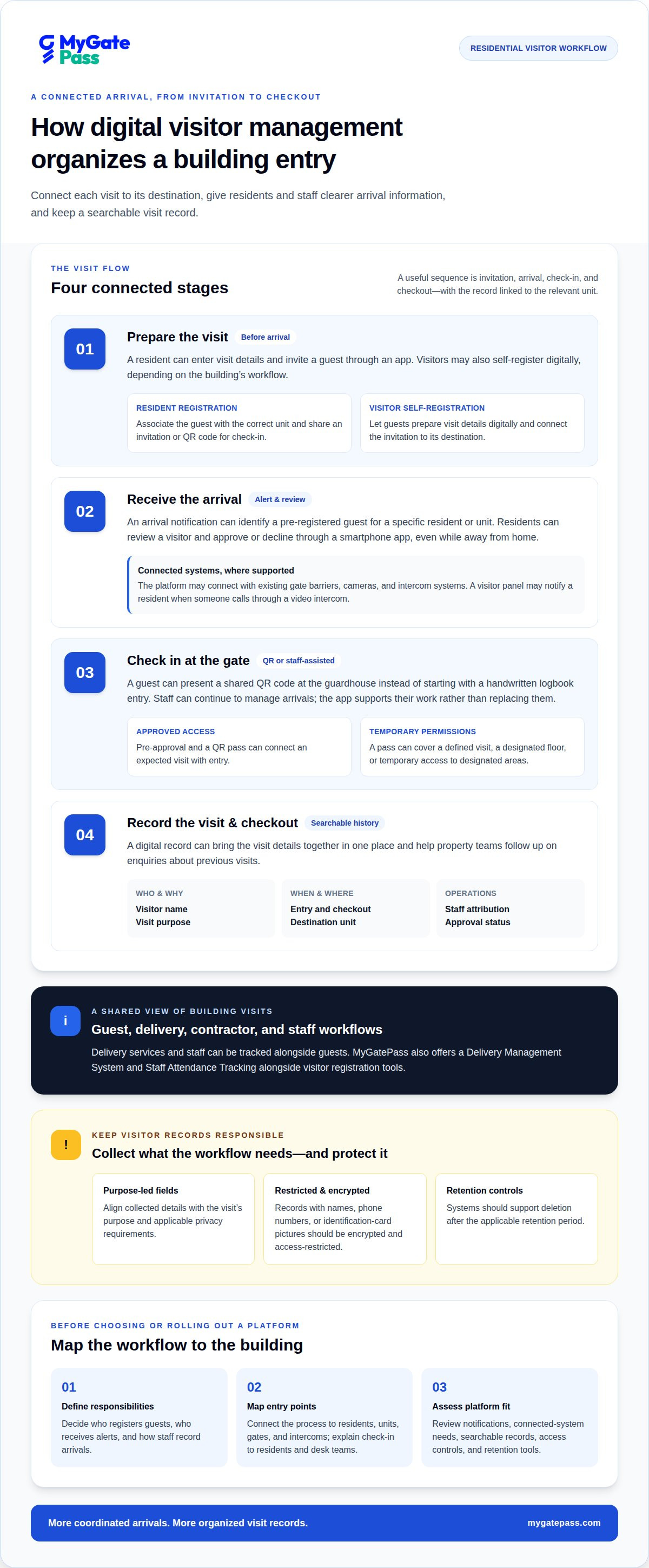
Connected gates and arrival alerts link a visitor’s check-in with resident or host notifications. A resident can receive an alert when a pre-registered guest arrives, or accept or decline a visitor through an app. For example, a visitor panel may notify a resident when someone calls through a video intercom. Where supported, the platform can also connect with existing gate barriers, cameras, and intercom systems. This helps staff and residents respond to arrivals with clearer, timely information.
Apps Compared with Paper Logs and Guards
A visitor app records entries digitally, while paper logs rely on handwritten details and guard-based check-in relies on staff recording arrivals. A digital record can connect a visitor’s name, purpose, entry time, destination unit, and checkout details in one searchable record. A guard can still manage the arrival workflow; the app supports that work rather than replacing staff. This distinction matters when a desk handles guests, deliveries, contractors, and maintenance teams during the same shift.
Resident notifications can support pre-approval and arrival decisions, while host notifications draw attention to a specific visit. For example, an alert can identify a guest for a particular unit instead of leaving staff to search a general log.
Visitor systems may record names, visit purposes, arrival and checkout details, destination units, and staff attribution. These are operational examples, not a universal legal checklist. UAE property teams should align collected fields with the visit’s purpose and applicable privacy requirements. Records containing names, phone numbers, or identification-card pictures should be encrypted and access-restricted. Systems should also support deletion after the applicable retention period.
Rollout starts by defining the building’s entry workflow: who registers guests, who receives alerts, and how staff record arrivals. Then map the process to residents, units, gates, and intercoms, and explain the check-in flow to residents and desk teams. Before choosing a platform, assess its notification workflow, connected-system needs, searchable records, access controls, and retention tools. Risks include overbroad record access, exposed personal details, and keeping records longer than needed.
Digital visitor registration and tracking
Digital registration connects a guest’s visit with its residential destination. Residents and visitors can use an app to prepare arrivals before check-in.
Resident Guest Pre-Registration
Resident guest pre-registration lets residents enter visit details and invite guests through an app. They can create a QR code for a guest to use at the guardhouse, replacing a handwritten logbook entry. For example, a resident can register a friend for a visit and share the invitation before arrival. The building team then has a visit associated with the correct unit.
Visitor Self-Registration
Visitor self-registration allows guests to register visit details digitally and receive an invitation through the app. This gives visitors a way to prepare for arrival without relying on a resident to enter every detail at the desk. An invitation can connect the visit to its destination, while a QR code can support check-in. The exact fields depend on the building’s registration workflow.
Visitor Approval and Tracking
Visitor approval lets residents review an arrival and approve or decline it through a smartphone app, even while away from home. The record can connect the visitor’s name and purpose with the destination unit, arrival, checkout, and staff attribution. These details give property teams a traceable visit history. For instance, staff can consult records when following up on an enquiry about a previous visit.
Keep the workflow clear for guests, residents, and desk staff. A useful sequence is invitation, arrival, check-in, and checkout, with each record linked to the relevant unit. Delivery services and staff can also be tracked alongside guests, giving teams a shared view of different visits. Explore digital visitor registration as part of a more connected building entry process.
In residential buildings, visitors are typically associated with a destination unit rather than an employee host. Residential visitor management systems can record a visitor’s name, purpose of visit, and entry time, giving property teams consistent details for each visit.
Residents can invite guests through an app and share a QR code for check-in, avoiding a handwritten guest logbook entry at the guardhouse. MyGatePass also offers a Delivery Management System and Staff Attendance Tracking alongside visitor registration tools, helping property teams coordinate these operational workflows.
License plate recognition and time-limited passes
Vehicle recognition and temporary passes can help manage visitor access at a gated residential building. Residents and property teams can connect approvals with a vehicle or a specific access period.
Pre-Approval and QR Passes
Resident pre-approval records an expected visit before the guest reaches the gate. Residents can approve visitors through a smartphone app, including while away from home, and issue a QR pass for entry. For example, a guest can present the pass at the guardhouse instead of starting an approval request on arrival. Property administrators can monitor approval status and assign temporary access to designated areas.
Temporary Visitor Passes
A temporary visitor pass gives a guest access for a defined visit rather than ongoing entry. A QR code can be set up for a designated floor, helping connect the guest’s permission with the intended destination. Time-limited passes can also support gated community access workflows. Property teams can use the approval record to understand who is expected and which areas the visit covers.
License plate recognition offers another way to manage vehicles entering a gated community. It can work alongside time-limited passes and blacklisting as part of an access-control workflow. These tools address different decisions: whether a visitor is approved, which access applies, and whether a vehicle should be managed under the building’s rules. The platform’s records help administrators review the visitor’s status.
Delivery drivers, contractors and recurring visitors can be handled as distinct visit types in building workflows. MyGatePass includes a Delivery Management System alongside its visitor tools, while visitor invitations and records help teams keep arrivals connected to their purpose. For recurring visitors, teams can follow the building’s applicable approval process rather than assuming every arrival has standing access.
Self-service visitor check-in and badges
Self-service check-in lets visitors complete arrival steps with less desk-side paperwork. QR codes and digital visitor history help connect each arrival with its visit.
Self-Service Check-In and QR Codes
QR code check-in lets a visitor present a digital pass at the building entry point. The scan can connect the arrival with an expected visit, making the process easier to follow than searching through a paper log. A cloud-based platform can also provide faster check-ins for small apartment buildings. For guests, the key benefit is a more direct path from invitation to entry.
Arrival and Checkout Records
Arrival and checkout records mark when a visitor enters and leaves the property. Together, these entries give staff a clearer timeline for a visit, rather than a record showing only that someone arrived. For example, a contractor’s visit can be associated with the relevant unit, purpose, and staff member. Consistent logging helps property teams review the visit history when an enquiry arises.
Visitor Badges
A visitor badge gives staff and residents a visible way to distinguish an authorised guest from others onsite. During check-in, the building can associate badge use with the visitor’s entry record and destination. This can help identify a guest in shared spaces. A badge supports the building’s entry process; it does not replace approval or accurate visit records.
For a smooth workflow, connect the visitor’s QR pass, arrival record, and badge process. At checkout, close the visit record so the building’s log reflects both entry and departure. Keep the steps understandable for guests and desk teams, especially in buildings that receive deliveries alongside personal visits. A visitor check-in workflow can bring these arrival steps together.
MyGatePass: MyGatePass Visitor App
MyGatePass offers the MyGatePass Visitor App for residential visitor management workflows. It sits alongside the MyGatePass Security App and MyGatePass Admin Dashboard, connecting visitor and security operations with central administration. The UAE Pass Integration Module supports verified visitor identification through integration with UAE Pass.
Consider this setup when your property wants to move visitor processes into a digital system and coordinate resident, security, and administrative workflows. The suitable combination depends on how your building handles arrivals and manages visitor information. Contact MyGatePass to discuss your building’s visitor management needs.
Make Your Building’s Next Entry Workflow Clearer
Choose a residential building visitor management app around the workflow your property wants to improve first. Start by agreeing who handles visitor decisions, what staff need to manage arrivals and how residents and building teams will use the system. A clear plan makes the technology part of everyday operations rather than another disconnected task, and gives residents and staff a shared understanding of how entry works.
MyGatePass brings together the MyGatePass Visitor App, MyGatePass Security App and MyGatePass Admin Dashboard for visitor and facility management workflows. Contact MyGatePass to discuss how the platform can support your building’s priorities and daily processes.
Contact MyGatePass to explore visitor management and take a practical step toward a more organised entry experience.
Frequently Asked Questions
What features should a residential building visitor management app include?
Look for features that match the building’s visitor workflow, such as resident invitations, approval options, delivery handling, and searchable visit history. A property with frequent deliveries may benefit from a dedicated delivery workflow, while a building that needs verified visitor identification can consider UAE Pass integration. Clear administrative access also helps teams manage records according to staff roles and building responsibilities.
How do visitor management apps integrate with access control, intercoms, and elevators?
Integration connects visitor approval information with compatible building systems. For example, an intercom call can prompt a resident notification, while connected access control can support an approved visitor’s entry. Elevator access may use a visitor’s authorised destination, such as a designated floor, when the building’s systems support that workflow. The exact connection depends on the equipment and software involved, so map the intended entry journey before deployment.
Do UAE data protection laws apply to visitor management apps and guest records?
UAE property teams should align visitor data collection with the visit’s purpose and applicable privacy requirements. Records containing names, phone numbers, or identification-card pictures should be encrypted and access-restricted, and deleted after the applicable retention period.
What visitor information can residential buildings legally collect in the UAE?
Buildings may record details such as a visitor’s name, purpose, destination unit, arrival and checkout times, and staff attribution. These are operational examples, not a universal legal checklist; collection should match the visit’s purpose and applicable privacy requirements.


