

Your security guards aren't failing your entry gates; your manual workflows are failing them. When vehicles back up down the street and paper visitor logs stack up on clipboards, it's tempting to assume your team simply needs to work faster. Yet if you're evaluating how to improve security guard performance across your properties, retraining personnel won't fix systemic bottlenecks created by manual badge checking, illegible handwriting, and slow phone verifications.
You already know how quickly peak-hour entry delays frustrate residents and visitors, just as you know how difficult compliance audits become when incident reporting remains scattered. True operational excellence comes from pairing dedicated personnel with the right digital tools. In this guide, you'll discover practical management strategies, smart digital workflows, and objective accountability metrics that eliminate vehicle congestion and elevate guard productivity. We will break down exactly how modern access systems transform frontline security from a daily friction point into a swift, dependable, and transparent operation.
Key Takeaways
- Pinpoint why manual logbooks consume up to seventy percent of guard attention, shifting focus from blaming personnel to fixing broken entry workflows.
- Discover how to improve security guard performance using balanced KPIs that evaluate station throughput without sacrificing access verification standards.
- Turn cumbersome paper binders into interactive digital post orders and checklists that ensure consistent protocol execution at every gate.
- Speed up vehicle queues by equipping frontline teams with the MyGatePass Security App for fast QR code scanning and automated visitor logging.
- Reduce operational turnover by implementing structured digital shift handovers and objective shift tracking to reward dependable officers.
Diagnosing the Operational Bottlenecks That Undermine Guard Productivity
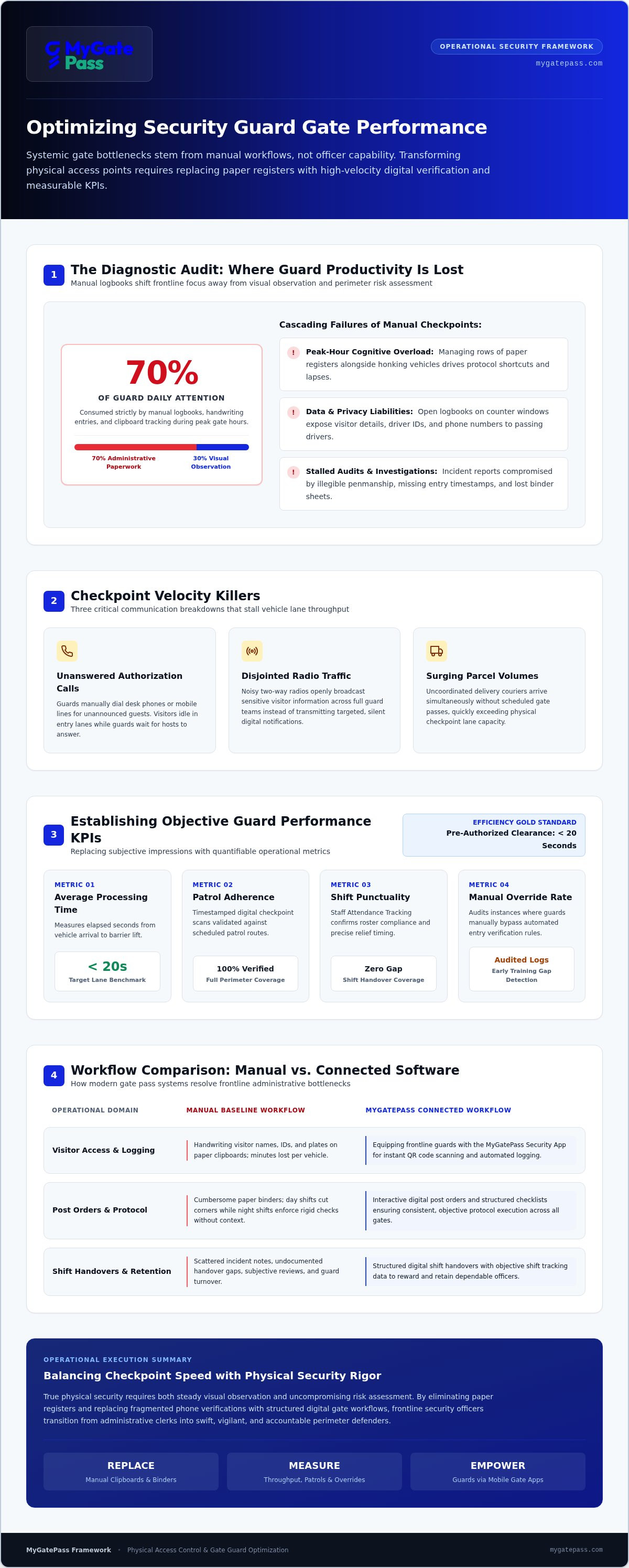
When security gates back up, facility leadership often points fingers at gate officers. That diagnosis is usually wrong. Manual administrative friction, not lack of vigilance, is the core issue sabotaging frontline productivity. When learning how to improve security guard performance, operational audits reveal that manual logbooks consume up to seventy percent of an officer's daily attention. Shifting a guard's focus down toward clipboards compromises the core objectives of comprehensive physical security measures, which depend on steady visual observation and fast risk assessment.
Peak-hour cognitive fatigue intensifies these operational failures. Guarding an active checkpoint requires rapid decision-making under pressure. Staring at endless rows of paper registers while managing honking drivers creates cognitive overload, directly driving protocol lapses. Without clear, dynamic guidelines, ambiguous post orders cause enforcement discrepancies between day and night shifts. Day shifts cut corners to clear lines; night shifts enforce rigid checks without proper context.
The Administrative Drain of Manual Gate Logbooks
Handwriting visitor names, driver IDs, and license plates wastes valuable minutes per vehicle. This delay creates cascading queues at high-density facilities. Paper registers also introduce significant privacy liabilities. Leaving open logbooks on a guardhouse counter exposes personal contact information to every driver who leans through the window. When incidents occur, investigations stall because paper records suffer from illegible penmanship, missing entry stamps, and damaged or lost pages.
Fragmented Communication Channels at Security Checkpoints
Disconnected communication cripples checkpoint velocity. When an unexpected guest arrives, guards must manually dial hosts or property managers for entry permission. These phone calls pull officers away from gate barriers. Key points of breakdown include:
- Unanswered authorization calls: Visitors idle in entry lanes while guards wait for hosts to pick up desk phones.
- Disjointed radio traffic: Noisy two-way radios broadcast sensitive gate details across entire teams instead of delivering targeted, silent digital alerts.
- Surging parcel volumes: Uncoordinated delivery couriers arrive simultaneously without scheduled gate passes, quickly overwhelming checkpoint lane capacity.
Resolving these communication failures is essential when planning how to improve security guard performance. Replacing fragmented manual verifications with structured digital checkpoints eliminates guesswork and lets officers focus on genuine perimeter protection.
Establishing Measurable KPIs to Track and Evaluate Security Performance
You cannot improve what you do not measure. Yet many facility teams still evaluate gate officers based entirely on anecdotal complaints or simple shift attendance. Understanding how to improve security guard performance requires quantifiable, operational benchmarks. Rigorous training models like the Federal Law Enforcement Training Program emphasize structural standards and risk assessment, principles that property managers must adapt for daily access points. Balancing rapid vehicle throughput against uncompromising identity checks creates a secure, welcoming environment.
Critical Quantitative Guard Metrics to Measure
Subjective impressions won't reveal operational bottlenecks. Instead, track these clear operational performance indicators across daily gate shifts:
- Average processing time: Measure the seconds elapsed from vehicle arrival to barrier lift. Efficient lanes clear pre-authorized visitors in under 20 seconds.
- Patrol checkpoint adherence: Track timestamped digital checkpoint scans against scheduled patrol routes to confirm complete perimeter coverage.
- Shift punctuality and attendance: Monitor roster compliance and relief timing using integrated tools like Staff Attendance Tracking to eliminate coverage gaps during shift handovers.
- Manual override frequency: Log how often guards bypass automated entry rules to catch training gaps early.
Qualitative Metrics: Hospitality and Incident Management
Speed means nothing if guards compromise site rules or alienate residents. Gate personnel serve as your community's frontline ambassadors. Their tone during tense situations sets the standard for the entire property. High-performing teams resolve entry disputes calmly, upholding access requirements without escalating friction with frustrated drivers.
Post-incident documentation represents another vital qualitative measure. Standard logs should be clear, detailed, and submitted immediately following an event. Vague summaries like "suspicious vehicle turned away" offer zero audit value. High-quality reporting details precise vehicle characteristics, timestamps, driver descriptions, and specific actions taken. Pairing objective data with regular reviews of visitor interactions provides a complete roadmap for how to improve security guard performance while keeping security standards intact.
How to Standardize Guard Protocols and Digital Post Orders in 5 Steps
Dusty three-ring binders sitting on guardhouse shelves don't protect facilities. When complex protocols are buried in dense paperwork, officers rely on memory, leading to inconsistent enforcement and gate delays. Standardizing post orders into interactive, digital operating procedures eliminates guesswork. This transformation gives officers clarity during stressful situations, directly supporting the core goal of study on security officer stress and performance findings that link clear operational expectations to higher frontline execution. Follow this five-step sequence to modernize post orders across all gates:
- Audit access points and traffic profiles: Map peak vehicle flows, high-frequency contractor entries, and parcel volume surges to identify where instructions fall short.
- Convert static binders into dynamic digital workflows: Break paragraphs of dense text into interactive, conditional step-by-step checklists on frontline mobile screens.
- Define tiered escalation pathways: Create unambiguous visual decision trees for rejected entries, invalid documentation, and aggressive drivers.
- Run weekly high-stress scenario drills: Practice processing delivery waves, tailgating incidents, and priority medical clearances using realistic simulations.
- Refine rules using operational analytics: Review entry denial rates and processing lag times weekly to eliminate ambiguous instructions.
Translating Static Policies into Interactive Checklists
Static operating procedures fail during peak hours. When looking at how to improve security guard performance, interactive digital checklists ensure officers execute compliance checks sequentially before opening gates. Start-of-shift workflows require digital acknowledgment of updated watchlists, banned license plates, or scheduled VIP visits. When property managers update building access rules, changes push instantly to frontline devices. Guards always operate from current instructions rather than outdated paperwork.
Scenario-Based Drills for High-Pressure Gate Events
Theoretical knowledge breaks down when five vehicles queue at a single entry lane. Practical simulation drills bridge the gap between policy and real-world execution. Run realistic drills covering three common flashpoints:
- Unregistered commercial deliveries: Train guards to route delivery drivers into secondary staging lanes immediately, keeping main traffic moving.
- Morning contractor surges: Standardize rapid trade credential checks and badge assignments using barcode validation rather than manual identity entry.
- Emergency responder access: Drill automatic barrier overrides and priority clearance protocols so ambulances or fire crews enter without delay.
Consistent scenario training combined with dynamic digital instructions gives guards the confidence to handle unpredictable gate rushes smoothly. It's the most reliable way to maintain fast entry lanes while enforcing access standards.
Modernizing Operations with Connected Gate Security Software
Punitive tracking tools miss the mark. While traditional software leans heavily on GPS monitoring to police guard locations, genuine operational breakthroughs happen when you remove administrative friction directly from the checkpoint. Equipping your frontline personnel with modern mobile platforms changes the entire dynamic. Instead of juggling clipboards and manual intercoms, officers manage vehicle queues with confidence. When addressing how to improve security guard performance, modern connected software acts as a true force multiplier, turning chaotic gate lanes into structured, automated workflows.
Empowering Frontline Guards with Intuitive Tablet Tools
Handwritten logs belong in the past. Deploying the dedicated MyGatePass Security App on ruggedized tablets lets officers scan pre-registered visitor QR codes in seconds. Arrival notifications push directly to residents' phones without requiring officers to place time-consuming verification calls. For incoming couriers, our integrated Delivery Management System provides instant drop-off logging and automatic tenant alerts. Entry queues vanish; officers stay alert and focused on perimeter safety.
Leveraging National Identity Verification for Seamless Compliance
Manual ID inspection leaves properties vulnerable to counterfeit physical documents and human oversight. Integrating verified digital credentials closes this vulnerability completely. With the UAE Pass Integration Module, officers validate visitor identities against official records with a single scan. This eliminates fraudulent entries and keeps compliance audits foolproof. Facility managers can explore how these frameworks align with statutory standards in our guide to UAE Pass building integration.
Centralized Administrative Oversight and Shift Accountability
Real-time visibility keeps operations running smoothly across every shift. Property supervisors can monitor post activity, review tamper-evident logs, and audit entry records through the centralized MyGatePass Admin Dashboard. Integrated Staff Attendance Tracking verifies officer punctuality across scheduled posts, eliminating attendance disputes between facility managers and security vendors. Discover how these high-tech safeguards compare with premier community hospitality in our digital gate pass guide.
Equipping your security team with purpose-built access technology resolves daily gate congestion while holding personnel accountable. Modernize your gate operations today to transform frontline security into a seamless, high-performance operation.
Building a Continuous Feedback and Guard Retention Framework
Technology alone will not solve checkpoint friction if guard turnover keeps resetting your operational baseline. The security sector faces massive turnover rates, reported as high as 88.6% in recent industry analyses, with guard replacement costs easily climbing from 50% to 200% of an annual salary. Constantly retraining new recruits drains administrative resources and compromises gate security. When determining how to improve security guard performance for the long run, property managers must implement a culture of objective feedback, transparent shift accountability, and positive recognition.
Weekly debriefs backed by system analytics replace subjective opinions with clear facts. Rather than interrogating personnel over anecdotal resident complaints, supervisors review concrete metrics like verified lane clearance times and exception logs. This shifts conversations from fault-finding to collaborative problem-solving, helping guards see management as an operational partner rather than an adversary.
Structuring Seamless Shift Handover Protocols
Information gaps between outgoing and incoming shifts leave properties exposed to security vulnerabilities. Structured digital handovers preserve complete situational awareness across round-the-clock rotations through three standard procedures:
- Digital task sign-offs: Outgoing guards must log unresolved contractor visits, overdue commercial deliveries, and open access tickets before closing their shifts.
- Immediate watchlist visibility: Incoming personnel review flagged license plates, banned individuals, and expected VIP arrivals directly on mobile dashboards upon sign-in.
- Tamper-evident transition stamps: Automated timestamps confirm that relief guards took over stations on schedule, closing dangerous unattended gate windows.
Data-Driven Recognition and Retention Strategies
High performance deserves visible acknowledgment. When software measures visitor processing speeds and patrol completion rates objectively, leadership can celebrate top-tier personnel instead of only penalizing errors. Rewarding officers who consistently meet processing targets fosters genuine professional pride. Overworked guards facing chaotic vehicle queues and messy paper logbooks quickly burn out; giving them intuitive mobile workflows lowers daily stress and stabilizes team retention.
Top performers can also be elevated into internal mentors who train incoming staff on digital station workflows. Providing a clear roadmap for mastering modern facility software gives officers tangible career progression within their assignments. Standardizing this feedback loop is a reliable strategy for how to improve security guard performance, transforming high-turnover gate stations into dependable, motivated security hubs.
Elevate Checkpoint Security with Modern Digital Workflows
Operational excellence at your access gates doesn't require heavier supervision or rigid micromanagement. When evaluating how to improve security guard performance across commercial or residential properties, the true solution lies in removing manual friction. Replacing bulky paper logbooks with interactive digital checklists and balanced throughput metrics empowers frontline officers to verify arrivals swiftly without compromising site integrity.
Modernizing your entry lanes transforms daily routines for guards, residents, and visitors alike. Instant QR gate pass scanning eliminates queue congestion, direct UAE Pass digital identity verification guarantees foolproof statutory compliance, and real-time administrative dashboards deliver clear shift visibility across all entry points. You don't have to choose between tight access control and smooth gate flow. Upgrade your gate operations with the MyGatePass Security App and give your security team the intuitive tools they need to succeed every single day.
Frequently Asked Questions
How can technology improve security guard performance without extensive technical training?
Purpose-built mobile applications simplify station tasks into visual, one-tap actions. When exploring how to improve security guard performance, user-friendly software removes the learning curve associated with complex legacy systems. Guards use intuitive tablet interfaces to scan entry passes, receive immediate visual clearance prompts, and log exceptions automatically. This guided workflow reduces administrative errors on day one, letting frontline officers focus on gate awareness rather than learning complicated software.
What key performance indicators should facility managers monitor at security gates?
Facility managers should focus on quantifiable operational velocity and security compliance metrics. Core benchmarks include average visitor clearance duration, scheduled patrol completion rates, shift attendance punctuality, and manual entry override frequencies. Monitoring these specific data points through a centralized dashboard highlights operational bottlenecks quickly. It also allows property leadership to evaluate vendor performance objectively, balancing rapid traffic throughput against strict access control enforcement across all posts.
How does replacing manual visitor logbooks with mobile apps reduce gate wait times?
Digital visitor passes eliminate the tedious minutes spent handwriting driver credentials and phone numbers into physical registers. Instead of guards manually telephoning residents to verify permissions, pre-registered guests present a digital QR code for instant scanning. The system automatically validates authorization and sends arrival alerts to hosts in seconds. This automated process slashes processing times from several minutes down to under twenty seconds per vehicle, clearing entry lanes rapidly.
Can digital gate pass systems integrate with national identification platforms like UAE Pass?
Yes. Modern platforms integrate directly with official identity networks through modules like the UAE Pass Integration Module. This allows frontline security personnel to verify resident and guest identities against official national records instantly. By replacing paper photocopies and manual ID inspections with verified digital credentials, properties elevate gate security, prevent credential forgery, and ensure full compliance with regional data protection and statutory identity standards.
What happens if a security guard encounters an unregistered visitor or delivery driver?
Unregistered arrivals follow a standardized digital registration workflow that prevents gate congestion. Guards use mobile tablets to log visitor details and initiate instant in-app authorization requests to residents. For parcel couriers, the Delivery Management System logs drop-offs and routes drivers to secondary holding bays. This approach keeps main entry lanes clear while ensuring every unexpected guest undergoes documented verification before receiving site entry clearance.
How does automated staff attendance tracking improve guard accountability across shifts?
Automated Staff Attendance Tracking creates transparent, tamper-evident digital records of guard check-ins and station handovers. This clarity is a fundamental factor in how to improve security guard performance across multi-shift facilities. Verified digital clock-ins eliminate coverage gaps, prevent unsupervised post transitions, and give property managers real-time visibility into active roster strength. Supervisors can objectively confirm contract compliance without relying on disputed manual timesheets.
How long does it take for a security guard team to adopt a digital visitor management app?
Most guard teams become fully proficient with intuitive mobile security apps within a single shift. Because purpose-built frontline interfaces mirror everyday smartphone applications, officers require minimal onboarding to master QR scanning, digital logbook entries, and delivery logging. Standardized digital prompts guide officers through each scenario, ensuring rapid adoption, immediate operational efficiency, and immediate reductions in gate vehicle queues without extended training cycles.


