

Long shifts aren't the primary reason your security officers are walking off the post; the true culprit is administrative friction. When frontline personnel spend hours juggling handwritten paper logbooks, answering repetitive driver queries, and defusing heated visitor confrontations at the barrier, cognitive fatigue sets in fast. For facility managers across the United Arab Emirates, preventing security guard burnout requires looking beyond simple roster adjustments and tackling the chaotic gatehouse bottlenecks that drain your team's energy every single shift.
You already know the compounding cost of constant officer churn, from recurring onboarding and vetting expenses to the heightened risk of unverified entries during morning rushes. In this 2026 guide, you'll discover how facility managers can eliminate cognitive fatigue, reduce costly turnover, and protect frontline security teams with modern operational strategies. We examine how automating administrative gate tasks and digitizing credential verification shields guards from mental exhaustion, creating an alert, resilient security operation where personnel actually want to stay.
Key Takeaways
- Recognize that manual paperwork and repetitive clerical logging are primary catalysts for severe frontline cognitive exhaustion.
- Apply a multi-layered strategy for preventing security guard burnout by addressing shift recovery intervals, gatehouse ergonomics, and daily task distribution.
- Replace physical visitor logbooks with digital pre-registration and fast credential scanning to eliminate peak-hour gatehouse pressure.
- Defuse entry checkpoint friction and hostile visitor interactions by shifting routine access validation to automated verification workflows.
- Foster lasting retention by pairing operational software visibility with leadership practices that value security personnel as essential community ambassadors.
What Is Security Guard Burnout and Why Is It Escalating?
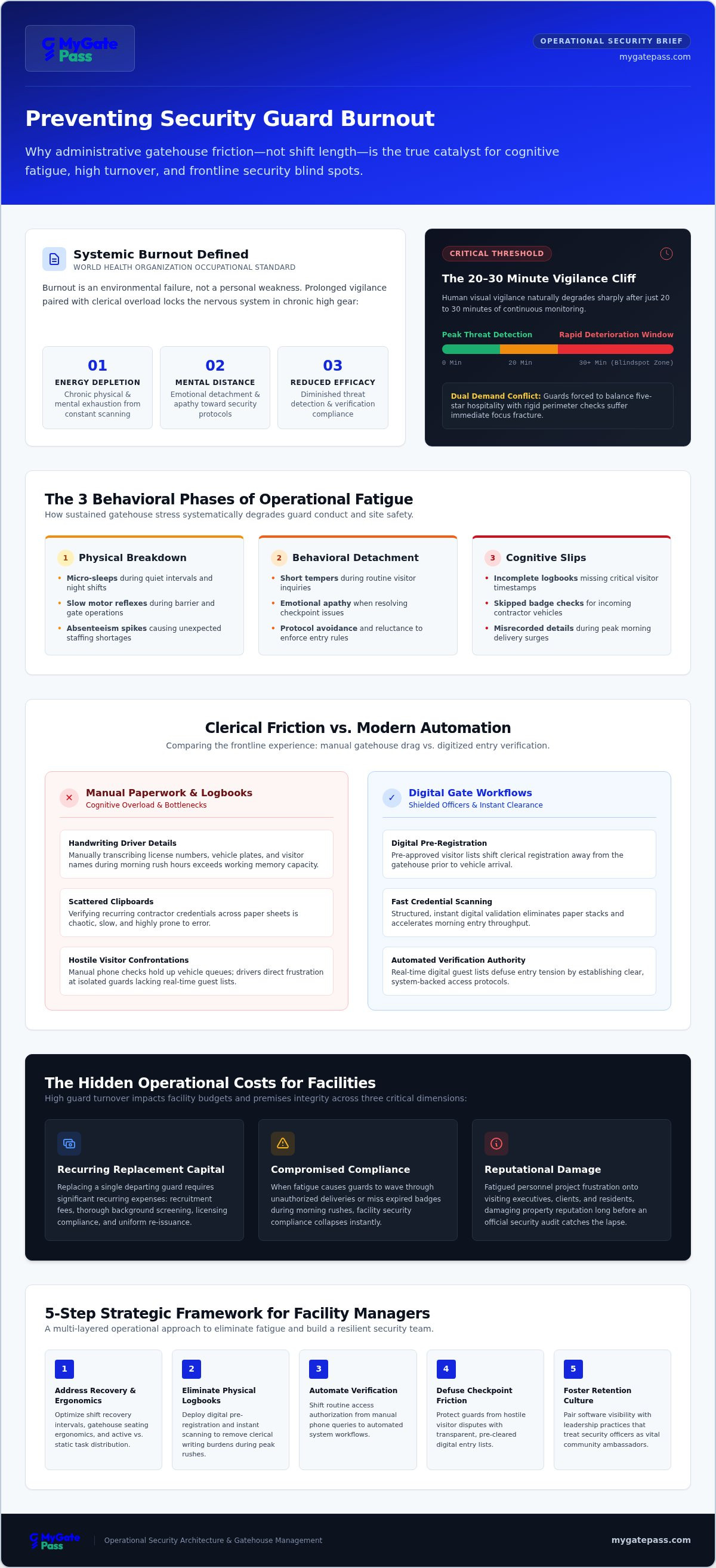
Security guard burnout isn't just an individual feeling tired after a long night. It's a systemic state of chronic physical, mental, and emotional exhaustion triggered by prolonged vigilance. When personnel spend entire shifts continuously scanning perimeters while managing administrative clutter, their nervous systems remain locked in high gear. This depletion aligns directly with the World Health Organization's definition of occupational burnout, which characterizes the condition through energy depletion, increased mental distance from job duties, and diminished operational efficacy. For commercial properties across the United Arab Emirates, preventing security guard burnout starts with treating it as an environmental failure rather than personal weakness.
High attrition reflects this reality. Turnover rates across private guarding regularly surpass other contract service sectors, forcing facilities into endless recruiting cycles. Alert fatigue quickly compounds the crisis. Human visual vigilance naturally degrades after just 20 to 30 minutes of continuous monitoring. When officers face relentless cognitive demands, their threat-detection thresholds collapse, creating security blind spots. Meanwhile, facility executives expect guards to deliver five-star hospitality while enforcing strict access rules. This dual demand fractures officer focus, leaving teams caught between greeting guests warmly and conducting rigid perimeter checks.
The Core Symptoms of Operational Fatigue
Operational exhaustion manifests across three distinct behavioral phases:
- Physical breakdown: Micro-sleeps during quiet intervals, slow motor reflexes during gate operations, and sudden spikes in unexplained absenteeism.
- Behavioral detachment: Short tempers during routine inquiries, emotional apathy, and reluctance to enforce basic verification protocols.
- Cognitive slips: Incomplete visitor logbooks, skipped vehicle badge validations, and misrecorded delivery details during morning spikes.
The Hidden Operational Costs for Facilities
Guard churn hits facility budgets hard. Replacing a single departing guard requires significant capital once recruitment, background screening, licensing, and uniform issues are calculated. When fatigue causes an officer to wave through an unauthorized delivery or miss an expired badge, premises compliance drops instantly. Worse, fatigued officers project their frustration onto visiting executives, clients, and residents. That friction harms property reputation long before an audit catches the lapse, making proactive workplace solutions a commercial necessity.
The Overlooked Drivers of Gatehouse Stress and Cognitive Overload
Most operations teams blame long shift rosters when officers resign. While shift duration matters, administrative friction is the silent catalyst that wears guards down. Static gate duty is deceptively demanding. Sitting in an enclosed booth tracking multiple surveillance feeds while managing vehicle queues drains mental energy faster than an active walking patrol. When officers must toggle constantly between clerical tasks and physical security, focus shatters. Effective strategies for preventing security guard burnout must dismantle this clerical friction before fatigue turns into operational failure.
The Burden of Manual Paperwork and Logbooks
Cognitive overload occurs when the mental effort needed to process administrative tasks exceeds an officer's working memory capacity. Manually handwriting driver license numbers, vehicle plates, and visitor names during morning rush hours creates immense bottleneck stress. Scattered clipboards make verifying recurring contractor credentials chaotic and error-prone. Forward-thinking sites reduce this clerical strain by adopting tools like modern gate management software, giving personnel structured, instant digital verification instead of paper stacks.
Hostile Interactions and the Customer Service Dilemma
Gatehouse teams routinely absorb the brunt of visitor frustration. When manual phone checks hold up a line of cars, drivers direct their annoyance straight at the guard. Officers must enforce entry policies without the backing of real-time digital guest lists, leaving them isolated in daily disputes. Constant emotional self-regulation during these tense confrontations rapidly exhausts an officer's decision-making stamina, aligning with findings in OSHA guidance on managing workplace stress regarding high-friction service environments.
Environmental and Ergonomic Strains
Physical post conditions accelerate mental exhaustion. Guard booths that lack adequate thermal insulation or robust climate control quickly become unbearable during peak summer weather across the United Arab Emirates. Poor booth layouts force officers to repeatedly stretch out of transaction windows and twist toward poorly mounted monitors, causing chronic muscular fatigue. Unaddressed isolation on solitary night shifts compounds the issue, especially when personnel lack intuitive digital channels to coordinate with central facility supervisors.
A 5-Step Strategic Framework for Preventing Security Guard Burnout
Stopping officer attrition requires more than issuing well-meaning wellness reminders. Sustainable operations demand an actionable framework that addresses rota design, physical gatehouse conditions, and daily operational bottlenecks. Industry research, including ASIS International's analysis of security staff burnout, demonstrates that unmanaged task monotony and prolonged vigilance directly trigger turnover. Facility directors must target the structural stressors built into daily checkpoint workflows. Systematically preventing security guard burnout requires executing a predictable, five-step blueprint across your commercial footprint.
Steps 1 and 2: Workload Auditing and Process Modernization
Begin by auditing site activity logs to map when gatehouse traffic peaks and identify which manual tasks cause backlogs. Eliminate redundant paperwork immediately. Transition personnel into forward-rotating posts where guards alternate every two hours between active foot patrols, barrier monitoring, and secondary checkpoints. Replacing physical log sheets with purpose-built digital apps removes continuous clerical recording. This operational pivot preserves officer attention for genuine safety anomalies instead of routine data entry.
Steps 3 and 4: Booth Optimization and Conflict Shielding
Physical environments dictate daily stamina. Ensure every checkpoint provides heavy-duty air conditioning, adjustable ergonomic seating, and glare-reducing glass coatings to counter extreme daytime heat across the United Arab Emirates. Combine booth upgrades with digital visitor pre-approvals. When visiting motorists present verified digital passes at the access barrier, entry rules are enforced by the system rather than the officer. This shift shields guards from argumentative drivers and drastically lowers emotional fatigue.
Step 5: Continual Performance Feedback and Recognition
Shift evaluations should build team confidence rather than assign blame. Implement these practical retention habits:
- Transparent time records: Track shift schedules and attendance collaboratively, avoiding punitive spot-checks when logistical delays occur.
- Security performance incentives: Reward guards who identify genuine property hazards or handle tense visitor inquiries with composure.
- Structured procedural feedback: Hold monthly operations debriefs where frontline officers can flag broken barrier hardware or faulty entry processes without fear of management blowback.
Digital Tools vs. Manual Workflows: Streamlining the Guard Experience
Paper logbooks turn capable security officers into stressed administrative clerks. When facility directors rely on clipboards, officers spend their energy scribbling license details, dialling apartment extensions, and verifying delivery slips. Switching to responsive digital tools fundamentally alters that dynamic. Automated workflows serve as a protective operational buffer, handling repetitive data capture so guards can focus on site safety. For site managers committed to preventing security guard burnout, software isn't just an efficiency upgrade; it's essential wellness infrastructure.
Eliminating Gatehouse Friction with Tablet Apps
Modern access control replaces manual clipboards with intuitive handheld interfaces. Using the MyGatePass Security App on post tablets, officers scan pre-registered visitor QR codes in seconds, eliminating awkward gatehouse cross-examinations. Residents pre-approve their guests through the MyGatePass Visitor App, removing the need for guards to place phone calls while vehicle queues build up behind the barrier arm. Security teams also avoid manual identification logging by leveraging national digital identity standards; learn how UAE Pass integration for buildings automates credential verification securely and smoothly.
Automating Deliveries and Staff Attendance
Package handling represents another major point of operational friction at modern entrances. Deploying a dedicated Delivery Management System stops parcels from accumulating in guardhouses, notifying recipients automatically upon courier arrival. At the same time, integrating Staff Attendance Tracking gives facility supervisors real-time visibility into post rotations without micromanagement:
- Transparent shift tracking: The MyGatePass Admin Dashboard displays live attendance, helping leadership identify understaffed posts before fatigue sets in.
- Conflict reduction: Automated credentialing prevents guards from being dragged into arbitrary gate disputes over entry permissions.
- Elevated professionalism: Officers shift from transactional gatekeepers to polished community ambassadors.
To see modern entry management in action, explore modern hospitality and community security protocols in our guide to digital gate pass apps. Ready to remove administrative bottlenecks across your property gates? Explore the MyGatePass platform to equip your frontline team with effortless gate operations today.
Creating a Sustainable Workplace Culture for Frontline Security Teams
Technology solves operational bottlenecks, but culture determines whether officers stay. Digital tools eliminate administrative clutter at the gate, yet long-term retention depends on how facilities treat the people wearing the uniform. When property managers treat contracted guards as interchangeable commodities, apathy takes root quickly. Preventing security guard burnout requires bridging the divide between frontline staff, facility executives, and property occupants. Elevating guards from invisible sentries into respected community ambassadors transforms the daily post experience into a sustainable, valued career.
Fostering Mutual Respect Between Residents and Guards
Community friction drops when residents understand gate protocols. Facility leaders should communicate access policies directly to occupants, reminding them that credential checks protect their own premises. When residents realize that pre-authorizing visitors saves everyone time, gatehouse relationships improve immediately. Back officers up publicly when they enforce property rules. Recognizing exceptional guards in community announcements or building newsletters shows the frontline team that their vigilance matters to everyone on site.
Equipping Teams with Intuitive Digital Infrastructure
Nothing demoralizes an officer faster than struggling with broken or convoluted software. Investing in user-friendly touchscreen tools signals respect for an officer's time and professional dignity. Keep these cultural priorities front and center:
- Clean, mobile-first design: Deploy accessible tablet applications with clear visual cues so guards never battle confusing sub-menus during peak arrivals.
- Confidence-building onboarding: Deliver brief, practical training sessions focused on real-world gate scenarios rather than dry technical documentation.
- Direct feedback channels: Hold regular check-ins where officers can voice operational roadblocks, allowing facility directors to fix broken site workflows quickly.
When leadership pairs reliable workplace tools with genuine human support, shift morale rebounds. Guards who feel equipped and valued stay focused, deliver warmer customer service, and protect community assets with pride.
Build an Alert, Resilient Frontline Operation
Protecting your team begins with eliminating the friction that drains their daily stamina. Long-term site security isn't just about managing rosters; it requires transforming the gatehouse environment to shield officers from clerical overload and hostile confrontations. Replacing paper records with modern operational workflows directly targets the cognitive fatigue that drives expensive guard turnover across the United Arab Emirates.
Achieving measurable progress in preventing security guard burnout requires the right tools. Frontline officers equipped with the dedicated MyGatePass Security App handle seamless tablet-based gate verification in seconds, dramatically reducing gate queue dwell times and daily friction. Simultaneously, the centralized MyGatePass Admin Dashboard gives property leadership transparent shift and delivery tracking without micromanagement. When you simplify daily workflows, you empower officers to protect your facilities with clarity and pride. Empower your security team with MyGatePass to build a modern, sustainable gatehouse ecosystem today.
Frequently Asked Questions
What are the early warning signs of security guard burnout?
Early warning signs include sudden spikes in gatehouse procedural errors, visible physical fatigue, and increasing friction during routine guest interactions. Supervisors should watch for incomplete entry logs, missed badge verifications, and uncharacteristic irritability toward residents. Chronic tardiness and last-minute shift call-outs also signal deep exhaustion. Catching these behavioral indicators early allows facility directors to intervene before fatigue leads to an on-site security breach or a sudden resignation.
Can technology really reduce burnout without cutting security staff?
Yes, modern software protects guard headcount by transforming officers from clerical data-entry clerks into focused security coordinators. Solutions like the MyGatePass Security App automate manual logging, credential validation, and phone calls. This automation eliminates administrative bottlenecks, allowing frontline officers to focus on perimeter surveillance, deterrence, and hospitality. Technology acts as a protective buffer against mental exhaustion rather than a tool to downsize personnel.
How many consecutive hours can a security guard work effectively?
Security guards maintain optimal cognitive alertness for roughly eight consecutive hours before vigilance drops substantially. After eight hours of continuous wakefulness, reaction times slow and sustained visual attention falters. Extended 12-hour shifts significantly increase accident risks and lapses in badge checking. Facilities aiming at preventing security guard burnout should institute mandatory forward-rotating schedules and structured rest intervals, ensuring officers have at least ten to twelve hours of recovery between shifts.
What causes the most daily stress for residential gate security officers?
The primary source of daily gate stress is resolving hostile confrontations with unregistered guests and impatient delivery couriers. When access rules rely on manual paper logbooks and phone confirmations, long queues form at the barrier arm. Drivers inevitably direct their irritation straight at the officer. This constant emotional strain, combined with repetitive handwriting tasks during morning and evening rush hours, rapidly exhausts an officer's daily decision-making stamina.
How does automated visitor management improve guard retention?
Automated visitor management improves retention by removing the aggressive gatehouse disputes and manual clerical strain that cause guards to quit. When guests arrive with digital passes validated through the MyGatePass Visitor App or verified via the UAE Pass Integration Module, clearance happens in seconds. Enforcing rules becomes system-driven rather than a personal argument. This eliminates daily confrontation, directly assisting facility managers in preventing security guard burnout across their sites.
What happens if a facility ignores chronic guard exhaustion?
Facilities that ignore guard fatigue face surging turnover expenses, premises liability exposure, and severe security vulnerabilities. Fatigued guards experience alert fatigue, causing them to overlook expired badges, unverified vehicles, or unauthorized trespassers. Beyond security risks, replacing burned-out guards forces facilities to incur continuous recruitment, background screening, and onboarding costs. Stressed gate staff also project frustration onto visiting clients and tenants, harming the property's operational reputation.
How do I convince property stakeholders to invest in guard wellbeing tools?
Frame the investment around operational risk reduction, decreased turnover costs, and elevated community service standards. Demonstrate that software like the MyGatePass Admin Dashboard and Delivery Management System reduces costly guard churn while speeding up gate clearance for residents. Show stakeholders that investing in frontline digital infrastructure protects premises liability and enhances tenant satisfaction. Highlighting how automated workflows replace recurring recruitment expenses presents a compelling financial case.


