

Strong physical barriers no longer guarantee facility safety. In 2026, building security compliance across the UAE is defined by verified digital identity rather than manual sign-in sheets. Managing high visitor volumes without compromising security is a persistent challenge. Slow entry gates test resident patience, while vulnerable paper logbooks expose your property to steep fines under national data protection laws. Your security team shouldn't have to choose between welcoming guests quickly and maintaining airtight access control.
Security and hospitality can work hand in hand. This guide provides a clear roadmap through current national visitor verification standards, showing you how digital identity integration ensures 100% compliance without administrative drag. We'll explore mandatory security requirements, demonstrate how automated verification eliminates identity fraud, and outline the exact steps to establish a smooth, paperless entry system for your entire property.
Key Takeaways
- Understand how modern regulations redefine building security compliance around digital data integrity and verified entry rather than basic perimeter checks.
- Discover how integrating national digital identity eliminates guest uncertainty, speeds up lobby traffic, and safeguards visitor privacy.
- Identify the critical compliance risks and data privacy liabilities hidden within traditional paper logbooks.
- Follow a practical 5-step checklist to evaluate your property's current entry protocols against national security mandates.
- Learn how centralized admin dashboards and specialized mobile workflows turn day-to-day security operations into a frictionless resident amenity.
What is Building Security Compliance in the 2026 UAE Landscape?
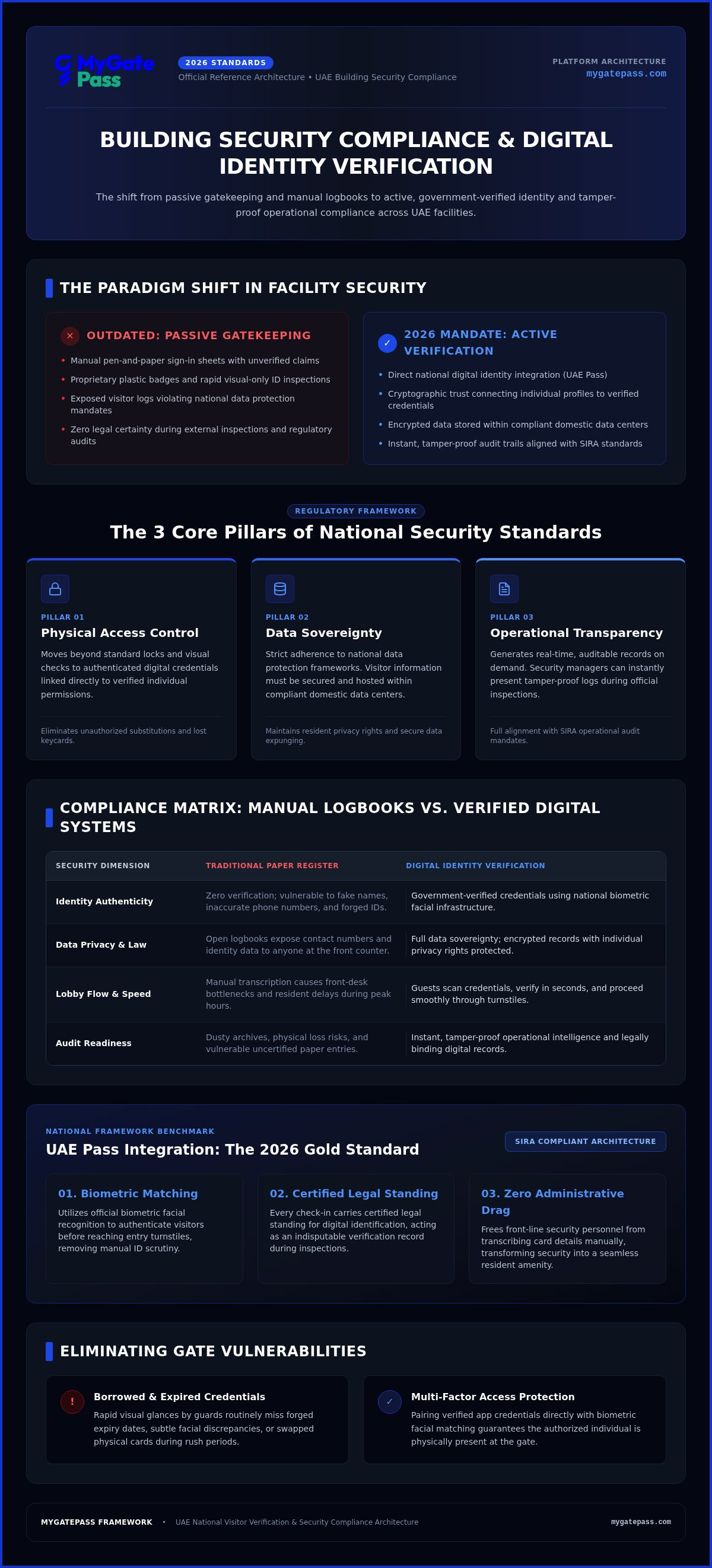
Modern building security compliance is no longer just about controlling who walks through a turnstile. It represents the intersection of structural safety and digital data integrity. National standards have moved past passive gate-keeping, where an attendant merely checks an ID card and writes down a name. Today, the focus is active identity verification. Facilities must know, with absolute certainty, who enters their premises while handling personal records under strict regulatory safeguards. Regulators in 2026 prioritize live, auditable operational intelligence over dusty archives of historical logs. For property owners and facility managers, failing to meet these unified benchmarks brings serious legal consequences, including severe financial penalties and administrative scrutiny.
The Core Pillars of National Security Standards
Meeting national expectations requires a balanced infrastructure that addresses both physical movement and information protection:
- Physical Access Control: Traditional locks and visual inspections are insufficient. Modern physical security strategies depend on authenticated digital credentials that connect individual permissions to verified profiles.
- Data Sovereignty: Collecting guest details requires strict adherence to national data protection frameworks. Visitor information must be secured, stored within compliant domestic data centers, and shielded from unauthorized exposure.
- Operational Transparency: Systems must generate instant, auditable records. When safety auditors request entry records, building managers must provide clear, tamper-proof logs instantly.
Why Traditional Security Methods No Longer Meet Compliance
Relying on manual guest registers introduces immediate operational vulnerabilities. Pen-and-paper check-ins rely on unverified claims; anyone can write an inaccurate name or fake phone number, leaving security teams with zero legal certainty regarding who entered the property.
Physical paper books also violate basic data privacy principles. Open logbooks expose previous visitors' personal contact numbers and identity details to anyone standing at the front desk. Under updated national data privacy laws, individuals retain rights over their personal information, including the right to have their data securely expunged. A paper registry cannot offer this level of control. Human error at the front counter slows down entry times, frustrates guests, and ultimately compromises building security compliance across your entire facility.
The Role of National Digital Identity in Security Standards
National digital identity has become the cornerstone of modern perimeter defense. Proprietary plastic badges and visual identification checks are relics of the past. Instead, facilities now leverage cryptographic trust established directly between citizens, residents, and national platforms. Integrating verified government identity into entry workflows elevates building security compliance from subjective guesswork into an airtight legal record. Encrypted, government-verified credentials significantly lower operational liability by eliminating fake credentials, unauthorized substitutions, and lost physical keycards. Guests simply scan their credential, confirm permissions in seconds, and proceed smoothly without front-desk bottlenecks.
UAE Pass Integration: The Gold Standard for 2026
Deploying native UAE Pass integration for buildings transforms gate operations completely. By utilizing the country's official biometric facial recognition infrastructure, the system authenticates visitors before they reach the turnstile. This takes heavy administrative pressure off front-line personnel, freeing them from transcribing card details manually or scrutinizing laminated documents. Regulatory bodies such as the Security Industry Regulatory Agency (SIRA) emphasize standardized, tamper-proof audit trails. Because UAE Pass carries certified legal standing for digital signatures and identification, every check-in recorded through it acts as an indisputable verification record during external inspections.
Eliminating Identity Fraud at the Security Gate
Traditional visual checks contain well-known blind spots that compromise facility protection:
- Borrowed or Expired Credentials: Guards conducting rapid glances often miss forged dates, subtle facial discrepancies, or swapped physical cards during rush periods.
- Multi-Factor Access Protection: Pairing app-based credentials with biometric facial matching ensures that the person carrying the device is the authorized owner.
- The Cryptographic Handshake: Systems replace subjective human observation with encrypted device-to-cloud handshakes, confirming access rights instantly against centralized databases.
Modern properties rely on verified digital frameworks to manage guest flows seamlessly. Exploring a dedicated platform through mygatepass.com helps management teams modernize their front desk while adhering to national identity benchmarks without friction.
Transitioning from Manual Logbooks to Digital Verification Systems
Paper logbooks carry massive hidden expenses. While a notebook seems inexpensive compared to software subscriptions, the administrative burden of archiving, storing, and manually auditing paper records drains operational budgets. Digital subscriptions consolidate these fragmented costs into predictable investments while closing severe security blind spots. Physical registers expose every visitor's name, phone number, and unit destination to whoever signs in next. This public display directly violates modern data privacy standards. Shifting to digital gate passes protects visitor confidentiality through encrypted databases, eliminates physical storage clutter, and cuts paper waste across busy gatehouses.
The Security Risks of Paper-Based Management
Relying on handwriting creates immediate vulnerabilities for building operations:
- Illegible Records and Fabricated Entries: Rushed visitors often scribble unreadable text or provide completely fictitious identities, rendering post-incident tracking practically impossible.
- Physical Vulnerability: Paper registers can be misplaced, water-damaged, or walked out the door, destroying weeks of irreplaceable visitor history instantly.
- Zero Operational Visibility: Facility managers cannot see who is inside a tower without physically walking to the gate and leafing through spiral notebooks page by page.
How Digital Systems Improve Operational Clarity
Digital architectures replace physical guesswork with instant operational oversight. Centralized dashboards allow security supervisors to oversee multiple vehicle gates and pedestrian turnstiles from a unified interface. When internal teams or local authorities launch an inquiry, safety personnel can filter thousands of entries by date, time, or guest profile in seconds rather than spending hours digging through filing boxes.
Connecting modern visitor management systems directly to overall facility metrics turns entry data into actionable intelligence. Automated reports compile peak traffic patterns, verify contractor duration times, and track delivery intervals with exact timestamps. This level of software-driven transparency directly bolsters building security compliance, transforming standard entry gates into reliable safety assets that keep property owners informed and protected.
A 5-Step Checklist for Building Security Compliance
Achieving total regulatory readiness requires an actionable operational framework. Instead of treating building security compliance as a reactive scramble before an inspection, forward-thinking operators use a structured checklist to align daily operations with national standards:
- Conduct a National Regulatory Audit: Review operational procedures against updated guidelines from relevant safety authorities and national police standards to eliminate procedural lapses.
- Implement Verified Identity Verification: Replace subjective visual inspections with cryptographic digital identity handshakes that confirm visitor credentials before gate arrival.
- Secure Your Data Storage: Transition guest records to cloud-hosted databases operating within domestic compliance boundaries, complete with end-to-end encryption.
- Empower Personnel with Dedicated Security Apps: Equip on-ground gatehouse teams with handheld software tools designed to scan, validate, and clear entries within seconds.
- Establish Real-Time Monitoring and Reporting: Maintain centralized administrative dashboards that log active occupancy and generate immediate, auditable reports on demand.
Auditing Your Current Security Infrastructure
Pinpoint access blind spots by evaluating every physical touchpoint across the perimeter. Courier drop-offs, contractor entries, and service bays often bypass standard protocols during rush periods. Review check-in duration metrics directly at the barrier. If processing a single guest takes longer than thirty seconds, bottlenecks form rapidly, tempting staff to skip verification steps. Finally, evaluate whether current record storage complies with national privacy mandates regarding data retention periods and explicit user consent.
Training and Empowering Security Personnel
Front-line gate staff face intense pressure during peak transit hours. Equipping them with responsive digital tools transforms their responsibilities from manual clerical duties to high-level access oversight. Intuitive mobile interfaces eliminate complex data entry, allowing team members to process pre-approved arrivals with a single screen tap. This technical clarity boosts staff confidence, reduces entry gate friction, and ensures that building security compliance remains uniform across every shift.
Upgrading your property's security framework doesn't have to disrupt everyday operations. You can audit your current gate workflows and upgrade your property's operations by visiting mygatepass.com to get started today.
Scaling Compliance with the MyGatePass Software Suite
Achieving consistent building security compliance across complex properties demands tools built specifically for modern operational demands. The MyGatePass software suite eliminates friction by connecting front-line teams directly to executive administration. At the gatehouse, the MyGatePass Security App serves as the primary tool for on-ground enforcement, empowering guards to validate credentials within seconds. Back in the office, the MyGatePass Admin Dashboard provides the operational clarity property managers need through centralized, live monitoring across every entry point. Coupling these solutions with the Delivery Management System ensures that high-volume courier arrivals, the fastest-growing entry category in modern properties, are processed securely. Residents enjoy faster deliveries and undisturbed privacy, while facility leaders maintain comprehensive security over every entry point.
A Unified Ecosystem for Community Security
Perimeter protection thrives when all parties participate in a coordinated digital process. When residents generate pre-approved invitations via the MyGatePass Visitor App, entry details sync instantly with the MyGatePass Security App at the gatehouse. Guards clear authorized guests with a simple scan, keeping driveways clear and eliminating the frustration of manual phone calls.
Service providers and third-party vendors require equal precision. Integrating staff attendance tracking brings operational transparency to contractor management, logging exact vendor check-in times and tracking work durations within specific zones. Powered by the UAE Pass Integration Module, this unified ecosystem verifies identities at a national standard, replacing cumbersome front-desk paperwork with a welcoming, hospitality-driven experience.
Future-Proofing Your Facility Management
Facility regulations evolve rapidly, yet physical access equipment remains expensive and slow to adapt whenever standards shift. Software-driven platforms provide continuous agility. Cloud updates deploy new regulatory features automatically, keeping your property fully aligned with national standards without disruptive hardware replacements. Whether overseeing a premium commercial high-rise or an expansive multi-phase residential development, the software scales effortlessly alongside expanding visitor volumes.
Modernizing your entry points protects your community while creating a smoother experience for every resident and guest. Book a demo of the MyGatePass ecosystem today to discover how intuitive digital workflows turn building security compliance into a seamless operational advantage.
Building a Compliant, Friction-Free Future for Your Property
Modern security is no longer an obstacle course of manual sign-ins and unverified claims. Upgrading to cryptographic identity verification closes dangerous data privacy gaps and shields properties against mounting regulatory penalties. By aligning everyday gatehouse operations with national standards, you protect personal data while turning building security compliance into an invisible standard of care that residents appreciate.
Safety and hospitality belong together. Direct UAE Pass integration removes identity uncertainty before guests reach the gate, while a centralized, real-time admin dashboard gives property managers effortless operational oversight across every access point. Supported by a modular software suite for visitors and security teams, your facility remains audit-ready and adaptable to future regulatory shifts. Streamline your building's security compliance with MyGatePass and deliver a sophisticated, welcoming entry experience your community can trust every single day.
Frequently Asked Questions
Is UAE Pass integration mandatory for building security in 2026?
While national regulations don't explicitly require every private doorway to use UAE Pass, adopting verified digital identity has become the baseline compliance benchmark across the country. Government and security regulators prioritize tamper-proof, verified entry logs over unverified manual entries. Using the UAE Pass Integration Module satisfies these national digital standards instantly, ensuring that your building security compliance remains completely audit-ready without relying on subjective physical document checks.
How does a digital visitor management system improve security compliance?
A digital visitor management system automates identification, access logging, and data privacy safeguards simultaneously. Instead of leaving visitor phone numbers and personal details exposed in open physical registers, the system encrypts and stores records in secure, compliant environments. It eliminates illegible handwriting and false names while generating immediate, timestamped audit trails. Facility managers gain instant visibility into active occupancy, strengthening building security compliance across every entry point.
What are the penalties for non-compliant visitor data handling in the UAE?
Non-compliant data handling can trigger severe financial and administrative penalties under national data protection frameworks. Exposing guest details in public logbooks or storing personal records on unauthorized servers violates statutory confidentiality laws. Penalties for serious data mishandling or privacy breaches can reach into hundreds of thousands of dirhams. Implementing encrypted, role-restricted digital platforms protects properties from these legal liabilities and shields visitor confidentiality.
Can MyGatePass integrate with existing gate hardware?
Yes, MyGatePass is designed as an agile, software-first ecosystem that works seamlessly alongside your existing physical infrastructure. Because the business does not manufacture physical gate hardware or provide guarding personnel, the software focuses entirely on modernizing access workflows. On-ground teams use the MyGatePass Security App on standard mobile devices or tablets to scan passes and clear entry points without needing costly hardware replacements.
How does digital compliance affect the resident experience in gated communities?
Digital compliance transforms community security into a premium lifestyle amenity rather than a daily hassle. Residents no longer deal with intercom interruptions or long queues at entry barriers when welcoming guests. Using the MyGatePass Visitor App, occupants generate pre-approved digital invitations that their guests scan upon arrival. Entry is swift and verified, giving residents complete peace of mind while preserving an elevated, welcoming hospitality atmosphere.
What is the difference between a visitor log and a verified identity pass?
A traditional visitor log merely collects unverified, self-reported claims written down on paper or typed into a basic form. In contrast, a verified identity pass links the visitor's record to authenticated national credentials using biometric verification or digital identification networks. This process guarantees that the person entering matches the digital credential presented, eliminating identity fraud and creating an indisputable record for security audits.
How do digital gate passes help in managing delivery couriers?
Digital passes bring speed and oversight to high-frequency courier traffic through specialized delivery management workflows. Couriers receive rapid, time-restricted access codes that grant entry only for the duration needed to complete the drop-off. Gate staff validate these credentials in seconds using handheld apps, preventing vehicle congestion at entrance gates while keeping accurate, time-stamped digital records of every delivery across the property.
Is my building's security data stored locally or in the cloud with MyGatePass?
MyGatePass stores access records securely within compliant cloud infrastructure aligned with national data sovereignty mandates. Storing data in protected cloud environments protects facilities against the physical loss, damage, or unauthorized access inherent in on-site paper books and local drives. Administrators access operational metrics, live entry logs, and compliance reports through the MyGatePass Admin Dashboard from any authorized browser at any time.


