

Over 80% of medium to large organizations in the UAE have transitioned to automated systems by 2026, yet many facilities still face a frustrating "peak hour pile-up" at the gate. You know the scene: a long line of idling cars, security guards frantically scribbling in smudged logbooks, and visitors growing impatient. It’s a high-pressure environment where safety often feels at odds with speed. When your security personnel are forced to choose between thoroughness and throughput, your entry processing times inevitably suffer, leaving your community vulnerable and your residents frustrated.
We understand that a secure entrance shouldn't feel like a bottleneck. Visits. Made simple. It’s possible to maintain a robust security posture without compromising the visitor experience. In this 2026 case study, you'll discover how digital visitor management reduces gate congestion and slashes entry processing times for modern UAE facilities. We'll examine how integrating national digital identity tools like UAE Pass, which now serves over 11 million users, transforms the arrival process into a seamless, worry-free interaction. This guide covers everything from real-time data clarity to the operational benefits of a connected community ecosystem.
Key Takeaways
- Understand why the arrival-to-entry duration serves as the primary pulse of your facility’s operational efficiency and resident satisfaction.
- Uncover the hidden security risks and time-consuming hurdles inherent in traditional manual logbooks and unverified visitor IDs.
- Compare the speed of manual verification against the instant, robust security provided by integrated UAE Pass digital identity systems.
- Explore a data-driven case study demonstrating how residential communities can slash entry processing times by 70% through digital transformation.
- Learn how to evaluate your current gate efficiency and implement modular software suites that offer operational clarity and a seamless visitor experience.
Understanding Entry Processing Times in UAE Facility Management
In the UAE's rapidly evolving facility management sector, we often focus on grand architectural designs or luxury amenities. However, the most critical metric for daily operations is often found at the perimeter. We define entry processing times as the total duration from the moment a visitor arrives at your community gate to the second they are granted authorized entry. It isn't just a number on a spreadsheet; it's the operational pulse of your community. While many online resources confuse this with visa timelines, facility managers know that physical gate efficiency is what actually dictates resident satisfaction and site security.
Premium residential and commercial sectors in 2026 have shifted toward a "frictionless entry" model. This approach minimizes hurdles without sacrificing safety. Achieving this balance requires a deep understanding of what is a digital identity and how it integrates with local security protocols. To master this flow, we focus on the three pillars of entry speed:
- Identification: Quickly capturing who the visitor is.
- Verification: Instantly cross-referencing that identity against authorized lists or national databases.
- Notification: Alerting the resident or host immediately to finalize the visit.
The Evolution of Gate Security Metrics
Traditional "wait times" only tell half the story because they don't account for why a delay happened. Modern "processing efficiency" benchmarks look deeper into the specific actions taken by security personnel. By leveraging real-time data, managers can now identify specific gate bottlenecks before they turn into traffic jams. This shift is powered by modern digital guard tools that replace old-fashioned stopwatch tracking with automated, centralized dashboards. These tools provide the operational clarity needed to move beyond guesswork and into data-driven management.
Why 2026 Demands Faster Processing
The demand for speed has never been higher. With delivery volumes reaching record levels in UAE communities, gates are under constant pressure to maintain throughput. Residents now expect smart-living standards that match the high-tech reputation of the Emirates. They don't want to wait for manual logbooks. Additionally, the UAE Personal Data Protection Law (PDPL) now mandates strict accuracy in how visitor data is logged and stored. Improving entry processing times through a digital system isn't just about convenience anymore; it's a baseline requirement for legal compliance and data security in a connected ecosystem. Visits. Made Simple. That’s the standard your residents deserve.
The Manual Logbook Trap: Why Traditional Entry is Failing
The manual logbook is a relic that creates a persistent bottleneck. We call this the "Handwriting Hurdle." When a guard stops to manually record a name, phone number, and ID details, it adds an average of 3 to 5 minutes per visitor. These minutes accumulate quickly. Before you know it, a single delivery driver has caused a backup that stretches onto the main road. This delay directly inflates your entry processing times, turning what should be a smooth arrival into a source of friction for everyone involved. Visits. Made simple. That is the goal, yet paper stands in the way.
Security risks are equally concerning. Paper logs are notoriously difficult to read and even harder to verify. If an unauthorized individual attempts to enter, a manual system has no way to flag them in real-time. You are essentially relying on a guard's memory and a ballpoint pen. This lack of operational clarity makes auditing a nightmare during security incidents. If you can't read the log, you can't verify the visit. It's a gap in your community's armor that modern residents simply won't accept.
The psychological toll shouldn't be ignored either. A long queue at the gate is a poor first impression for guests and a daily frustration for residents. It suggests that the community is poorly managed or stuck in the past. Beyond the gates, there is a hidden financial drain. Your team likely spends hours every week reconciling these messy paper records for monthly reports. Moving toward a centralized digital dashboard allows you to reclaim those labor hours and focus on higher-value tasks while fostering a sense of modern connectivity.
Data Inaccuracy and Security Vulnerabilities
Manual systems fail because they are static. They don't update when a contractor's permit expires or when a visitor is blacklisted. Transitioning from paper-based logs to cloud-stored records is now a necessity for compliance with the UAE's Personal Data Protection Law. Digital records ensure that every entry is backed by verified data, making audits instantaneous and reliable. It's about moving away from guesswork and toward a robust, high-tech ecosystem.
The "Peak Hour" Crisis in Community Management
Every large community faces the morning rush and the evening delivery surge. Manual systems scale poorly because they rely on physical speed. As your community population grows, the paper logbook becomes a liability. Gate saturation occurs at the exact point where the visitor arrival rate exceeds the gate's processing capacity. This saturation leads to erratic entry processing times and puts immense pressure on security personnel, often leading to skipped steps just to clear the line. Breaking this cycle requires a shift from manual paperwork to digital efficiency.
Digital Transformation: UAE Pass vs. Traditional Verification
Traditional gate security relies on a physical exchange: the visitor hands over an ID, and the guard manually inspects it. This process is slow, prone to transcription errors, and creates a clear bottleneck. In 2026, with over 11 million people using UAE Pass, this manual method has become an unnecessary hurdle. Moving toward UAE Pass building integration allows for a digital handshake that is both instant and indisputable. By pulling data directly from verified official records, you eliminate the risk of typos or misunderstood names that plague manual logs. It’s a shift from "guessing" to "knowing."
Verified Entry using national digital identity creates a high trust factor. Visitors today are often hesitant to hand over their physical Emirates ID to a stranger at a gate. Digital verification allows them to maintain control of their physical documents while providing the necessary credentials through a secure, encrypted process. This modernized approach doesn't just improve security; it fosters a sense of hospitality and respect for the visitor's privacy. When the system handles the heavy lifting of data capture, your entry processing times drop from minutes to mere seconds.
The Role of Pre-Registration in Speed
Pre-registration is the ultimate friction-reducer. By using the MyGatePass Visitor App, residents can invite guests in advance, sending a secure QR code directly to their phones. This removes the entire data-entry burden from the security gate. We call this the "10-second entry." Instead of stopping to provide details, the visitor simply presents their code for a quick scan. This instant validation triggers a real-time arrival notification for the resident, ensuring the host is ready before the guest even reaches their door. It’s a seamless flow that keeps traffic moving and residents happy.
Integrating UAE Pass for Security Personnel
On the other side of the gate, the MyGatePass Security App simplifies the guard’s role significantly. There’s no need for complex manual protocols or thick training manuals. A single scan of a QR code or a UAE Pass digital token provides all the necessary information in an easy-to-read format. This technology ensures full compliance with the UAE’s Personal Data Protection Law (PDPL) by using encrypted digital logs rather than exposed paper records. For security teams, this means less stress during peak hours and more time to focus on actual site safety. Training becomes a matter of minutes, not days, allowing your team to stay "one step ahead" in a high-tech ecosystem.
By digitizing the verification process, you're not just speeding up the gate; you're professionalizing the entire arrival experience. This connected community approach ensures that every visit is smooth, secure, and worry-free. Reducing entry processing times is simply the natural result of choosing modern, robust tools over outdated manual traps.
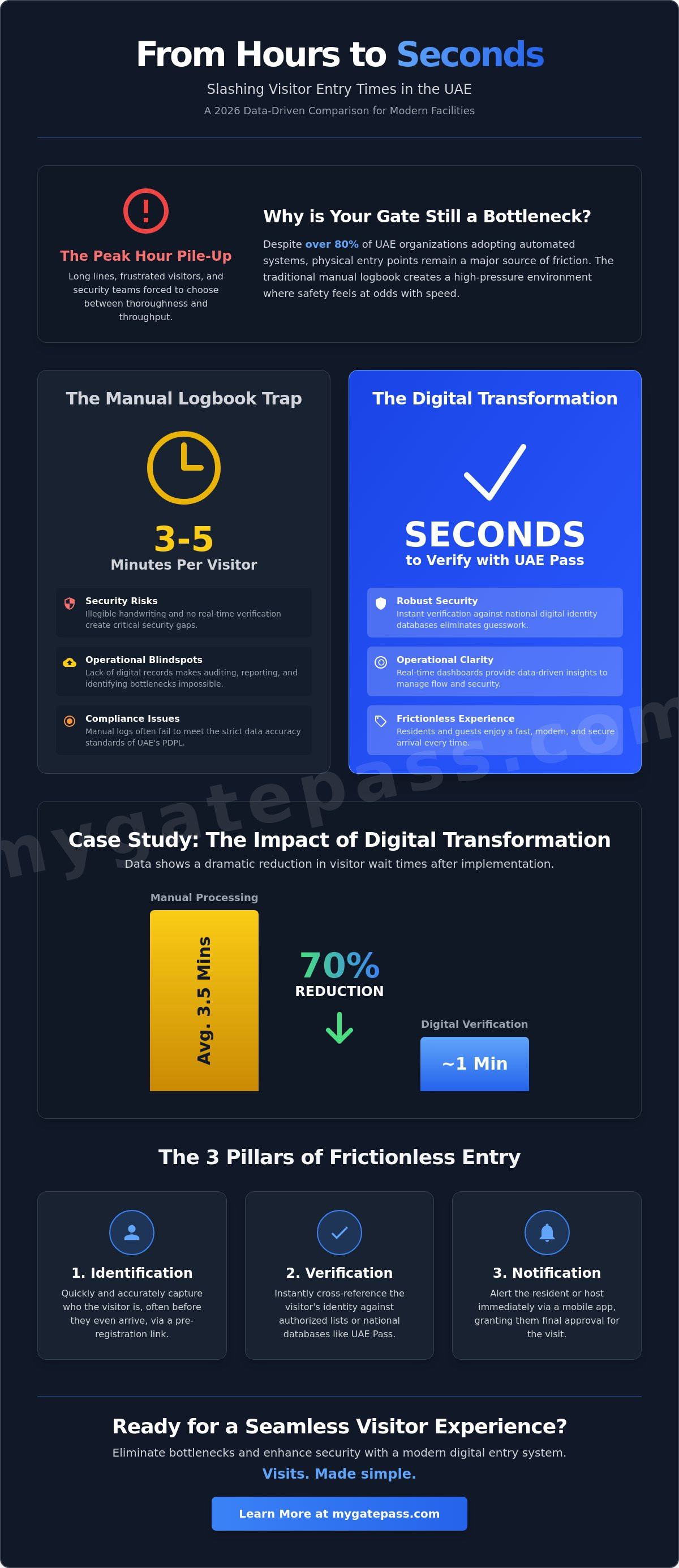
Case Study: Reducing Visitor Wait Times by 70%
Consider a typical 500-unit residential community in the UAE. Before adopting a digital ecosystem, this facility relied on traditional manual logbooks. Security guards were forced to balance thoroughness with speed, often resulting in average entry processing times of four minutes per vehicle. During the evening rush, this bottleneck created a stressful environment for staff and residents alike. The manual trap wasn't just slow; it was a barrier to the "worry-free" living experience promised by premium developments. Visits. Made Simple. That was the goal when management decided to overhaul their arrival workflow.
The intervention involved a full rollout of the MyGatePass software suite. By replacing paper with the MyGatePass Security App, the community transformed its perimeter into a high-tech gateway. The results were immediate and measurable. Within the first month, processing times dropped from four minutes to under 60 seconds per vehicle. This 75% reduction in wait times didn't just clear the roads; it fundamentally changed how visitors and residents interacted with the facility's security team.
Methodology: How the Efficiency was Gained
The transformation wasn't accidental. It was the result of a structured, three-step approach designed to eliminate friction at every touchpoint:
- Step 1: Shifting to Pre-Registration. By encouraging residents to use the Visitor App, 60% of guests arrived with a pre-authorized mobile gate pass. This removed the need for data capture at the gate.
- Step 2: Empowering Personnel. We equipped security guards with tablet-based scanning tools. This allowed for instant verification of IDs and QR codes, removing the "Handwriting Hurdle" entirely.
- Step 3: Centralizing Logistics. A dedicated Delivery Management System was implemented to handle the high volume of courier traffic. This ensured that delivery drivers followed a streamlined, designated path without clogging resident lanes.
Quantifiable Benefits for Management
The impact extended far beyond the front gate. Facility managers reported a significant reduction in staff overtime costs because gate operations no longer required extra personnel during peak hours to manage the queues. Resident satisfaction scores regarding building security saw a 25% increase, as homeowners appreciated the blend of enhanced safety and modern convenience. Digital entry processing times reduce labor costs while doubling gate throughput capacity. This case study proves that operational clarity and security go hand in hand.
Ready to see these results in your own facility? Explore the MyGatePass Visitor App and start your journey toward a frictionless community today.
Implementing a Modern Entry System in 2026
Transitioning to a digital visitor management system doesn't have to be a disruptive event. For facility managers in the UAE, the goal is to shift from manual chaos to operational clarity without a single minute of downtime. Start by evaluating your current gate efficiency. If your security guards are still juggling physical IDs and paper logs, your entry processing times are likely much higher than the 2026 industry standard. A modern system should be a friction-reducing partner that empowers your team rather than a complex burden they have to manage.
Choosing a modular software suite is vital. Avoid rigid, hardware-heavy systems that require expensive gate modifications or proprietary equipment. A software-based approach allows you to deploy the MyGatePass Security App on existing tablets or mobile devices, ensuring a smooth and rapid rollout. This flexibility means you can scale your operations as the community grows, adding modules for delivery management or staff attendance whenever you're ready. It’s about building a connected community ecosystem that stays one step ahead of future demands. Visits. Made Simple.
A successful transition relies on a "parallel run" strategy. Keep your manual logs active for the first 48 hours while your team gets comfortable with the digital interface. Because modern apps are designed with sophisticated simplicity, most guards find the digital workflow much more intuitive than traditional paperwork. This lack of a steep learning curve ensures that security isn't compromised during the switch. In the competitive UAE real estate market, a seamless arrival experience is more than a utility; it’s a lifestyle perk that sets your property apart from the rest.
Key Features to Look For
When selecting your platform, prioritize features that offer long-term reliability and modern connectivity. A real-time admin dashboard is essential for monitoring traffic flow and identifying potential bottlenecks instantly. Seamless integration with national identity platforms, specifically UAE Pass, is no longer optional; it is a baseline requirement for verified security. Finally, ensure the system includes offline mode capabilities. Security shouldn't stop during a network outage, and your digital records must remain robust and accessible at all times.
Next Steps for Community Boards
Your first move should be a "gate audit." Measure your current entry processing times during peak hours to establish a baseline for improvement. Once you have this data, it's time to see the technology in action. Scheduling a demo allows you to see how a digital gate pass app fits your specific facility layout and resident needs. Don't let outdated processes hold your community back from its full potential. Contact MyGatePass to optimize your facility entry today.
The Future of Seamless Gate Management
The era of paper logbooks and gate congestion is behind us. By embracing digital transformation, facility managers can turn a standard security checkpoint into a high-tech gateway that values everyone's time. We've seen how shifting to a robust, connected ecosystem doesn't just improve security; it reshapes the entire visitor experience. Integrating with UAE Pass provides verified identity while slashing your entry processing times by up to 70%. This level of efficiency offers real-time operational clarity that was once impossible with manual records. It’s about building trust through technology.
Visits. Made Simple. That’s the promise of a modernized facility. When you prioritize the human element of visitor management, you create a community that feels safe and welcoming from the very first interaction. Don't let outdated processes hold your property back in a market that demands excellence. Upgrade your community security with MyGatePass—Book a Demo today to see how sophisticated simplicity can transform your operations. Your facility deserves a concierge-style approach that stays one step ahead, ensuring every arrival is smooth and every resident is satisfied.
Frequently Asked Questions
What is a good benchmark for entry processing times at a security gate?
A digital benchmark for modern UAE facilities is under 60 seconds per vehicle. While manual systems often take three to five minutes, digital verification through pre-registration or UAE Pass integration significantly reduces this. Aiming for sub-minute processing ensures a smooth flow even during peak hours. This benchmark helps maintain resident satisfaction and prevents traffic backups onto public roads.
How does UAE Pass integration speed up visitor check-ins?
UAE Pass integration speeds up check-ins by pulling verified identity data instantly from national records. Instead of a guard manually typing in details, the system performs a digital handshake. This eliminates the "Handwriting Hurdle" and ensures data accuracy. It transforms a minutes-long manual check into a few seconds of digital validation, making the arrival experience worry-free for both visitors and staff.
Can digital visitor management systems work without expensive gate hardware?
Yes, modern systems like MyGatePass are software-based and don't require proprietary hardware or gate modifications. Security personnel can use standard tablets or mobile devices to scan QR codes and verify identities. This modular approach allows for rapid deployment without the high costs of physical infrastructure. It provides a high-tech ecosystem using tools your team likely already knows how to use.
Is it possible to track contractor and staff entry processing times separately?
Absolutely. The MyGatePass Admin Dashboard allows you to categorize different visitor types, such as residents, contractors, or delivery personnel. You can monitor entry processing times for each group individually. This operational clarity helps you identify if specific groups are causing bottlenecks, allowing for targeted improvements in your site's access protocols. Visits. Made Simple.
What happens to entry processing times if the internet goes down?
Reliable systems include an offline mode to ensure security remains uninterrupted during network outages. Data is stored locally on the security device and syncs automatically once the connection is restored. This ensures that entry processing times don't spike due to technical glitches. Your community stays secure and connected, even when the internet isn't, maintaining a seamless flow at the gate.
How do real-time arrival notifications improve gate efficiency?
Real-time notifications alert residents the moment their guest is verified at the gate. This removes the need for security guards to make manual phone calls to confirm every visit. By automating this step, the guard can immediately focus on the next vehicle in line. It's a simple change that significantly increases gate throughput and provides a concierge-style experience for the resident.
Do digital gate passes comply with UAE data privacy laws?
Yes, digital systems are designed to comply with the UAE Personal Data Protection Law (PDPL). Unlike paper logbooks, digital records are encrypted and stored securely. This ensures that personal information is only accessible to authorized personnel. Moving to a digital platform actually improves your compliance posture by replacing exposed paper records with a robust, centralized data management system.
How long does it take to train security guards on a new digital entry system?
Training usually takes less than an hour because the apps are designed for sophisticated simplicity. Most security personnel are already familiar with mobile apps, making the transition from paper very intuitive. Because the system guides them through each scan and verification step, the risk of human error is greatly reduced. This quick learning curve ensures there is no operational downtime during the switch.


