

A delivery isn't complete when a driver reaches the address; customers also need clear updates and reliable proof that an order arrived. Across the UAE, MyGatePass delivery management software brings route planning, delivery updates, and proof of delivery into one workflow, helping teams track deliveries across buildings and homes and review clearer records.
Digital route and communication tools can help teams manage deliveries more consistently. The practical gains come from connecting the steps: assigning orders, tracking progress, recording delivery outcomes, and giving managers a clearer view of operations.
This guide explains how delivery software can improve customer experience and reporting, what route optimization and electronic proof of delivery involve, and what to consider when choosing a solution for UAE operations. You’ll also see how MyGatePass supports building-level handovers and makes delivery records easier to review.
Key Takeaways
- Use timely customer notifications and tracking links to make delivery progress easier to follow and reduce uncertainty about arrival.
- Plan routes around delivery windows, vehicle capacity, traffic patterns and driver shifts to make each run more efficient.
- Assign orders with tower and villa handovers in mind, so drivers have clear delivery details before they reach each stop.
- Capture electronic proof of delivery, such as a time-stamped photo, signature and location data, to support clear records when a delivery is disputed.
Why Is Proof of Delivery So Valuable?
Proof of delivery connects the customer’s order to a recorded handover, helping teams resolve questions with clear information. In Dubai, delivery tracking can use driver smartphones, vehicle GPS trackers, or both.
Customer Notifications and Tracking Links
Notifications and tracking links let customers follow an order without calling dispatch for every update. A useful update makes the current status easy to understand and flags meaningful changes, such as an order being assigned or nearing arrival. For a building delivery, customers can use the update to prepare for the driver.
Review status wording and notification timing during setup. If a delivery is delayed, a clear status helps set expectations; when it is complete, the customer can see that the order has reached its recorded endpoint. This keeps delivery updates tied to the order instead of scattered across calls and messages.
Live GPS and Delivery Status
Live GPS tracking shows a driver’s location on a management dashboard, while delivery status explains what is happening with each order. Location indicates progress along a route; status records steps such as assigned, in transit, or completed. Dispatch teams can use both views to identify deliveries that need attention.
For driver management, link each assigned order to its status and location view. Dispatchers can compare the planned stop sequence with the driver’s progress and follow up when an order’s status does not change. Tracking may use a driver’s smartphone, a vehicle tracker, or both.
Shipment tracking also supports clearer ETA updates. An ETA is an estimate based on delivery progress, not proof that a handover took place. Customers can use an updated arrival estimate to plan access, while dispatch can review delays and decide which orders need follow-up.
A recorded delivery outcome gives customer feedback useful context. If someone reports a missing order, the team can compare its status and available delivery record with the booking. This creates a clear path from the customer’s question to an operational review, rather than relying only on memory or separate messages.
Route optimization
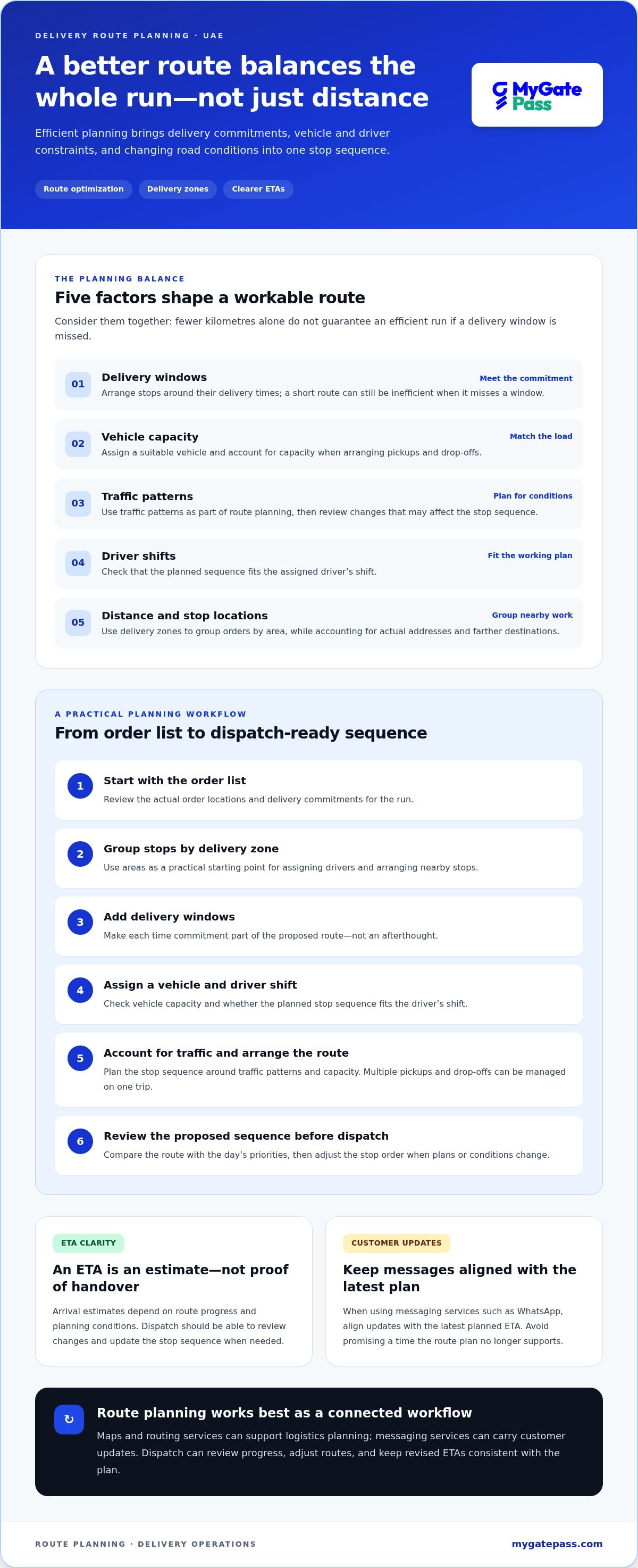
An efficient UAE delivery route balances distance with delivery windows, vehicle capacity, traffic patterns, and driver shifts. Dispatch teams can use these factors to plan stops and manage multiple pickups and drop-offs on one trip.
Route Planning and Delivery Zones
Delivery zones group orders by area, giving dispatch a practical starting point for assigning drivers and arranging routes. For example, a run serving several Dubai neighbourhoods can group nearby stops before adding farther destinations. Review how the platform handles each delivery address, time window and vehicle capacity, then check that the planned sequence fits driver shifts.
Delivery Route Optimization and ETAs
Route planning weighs distance, delivery windows, vehicle capacity, traffic patterns, and driver shifts. A route with fewer kilometres may still be inefficient if it misses a delivery window. Accurate ETAs depend on route progress and planning conditions, so dispatch should be able to review changes and adjust the stop sequence when needed.
For deliveries across the UAE, route planning should reflect actual order locations and timing rather than assume one route suits every run. Multiple pickups and drop-offs can be managed on a single trip, helping dispatch organize a sequence around collection points and delivery commitments.
A practical planning workflow starts with the order list. Group stops by delivery zone, add each delivery window, then assign a suitable vehicle and driver shift. The system can account for traffic patterns and capacity when arranging the route. Managers can compare the proposed sequence with the day’s priorities before dispatch.
Integration also matters. Logistics platforms commonly connect with maps and routing services, while messaging services can support customer updates. If dispatch uses WhatsApp, align updates with the latest planned ETA; a message should not promise a time that the route plan no longer supports.
When evaluating delivery management software in Dubai, consider how route changes appear to dispatch and how revised ETAs reach customers. A clear workflow helps teams respond to updated routes and keep delivery plans accurate.
Dubai Delivery Software for Towers, Villas & Same-Day Slots
Compare platforms by how clearly they connect vehicle location, route planning, and completed-order evidence. For UAE customer data, assess applicable privacy requirements, access controls, and retention. Also consider practical risks such as inaccurate addresses, weak connectivity, and outdated order details.
Order Management and Driver Assignment
Order management should connect each booking with its address, delivery slot, and handover instructions. Dispatch can assign the order to a driver and suitable vehicle, taking route and workload into account. For building deliveries, include building and access details; for homes, make the entrance location clear. Review how staff can correct an address or reassign an order before dispatch.
Dashboards and Driver Apps
For Dubai teams, check whether manager dashboards and driver apps support Arabic and English workflows. The dashboard should make order status and assignment information easy to scan, while the mobile app should present drivers with the details needed for their stops. Test common tasks in both languages, such as opening an order, updating its status, and reviewing its delivery instructions.
Driver and Customer Management
A useful platform keeps driver assignments and customer order details connected, so dispatch can see who is handling each delivery. Review how it manages changes, such as a customer updating a villa location or a manager assigning an urgent same-day slot. Clear records help teams distinguish an address issue from a driver assignment issue and direct follow-up to the right person.
Fleet Tracking, Routes, and Proof of Delivery
Compare fleet tracking by checking how the platform presents vehicle location and order progress together. Assess route planning separately: it should account for delivery windows, vehicle capacity, traffic patterns, and driver shifts. Then review proof of delivery, such as a time-stamped photo, signature, or location data. These features serve different purposes, so a good fit connects route decisions with a clear record of each handover.
Electronic proof of delivery
Electronic proof of delivery records the handover against its order, giving dispatch a reviewable account when questions arise. In Dubai commerce, the record can connect a completed stop with the customer’s order and delivery updates.
Digital Delivery Confirmation
A digital confirmation can combine a time-stamped photo, signature, and location data. Together, these details help show when and where a driver marked an order complete. If a customer disputes a delivered parcel, the team can review the recorded handover instead of relying only on a status update. Check which evidence the driver app captures and how dispatch can retrieve it by order.
Proof of Delivery and Cash Collection
For cash-on-delivery orders, reconciliation can connect collected amounts with the relevant orders and drivers. This helps managers compare delivery completion with collection records. Check how the platform distinguishes a completed handover from a payment that still needs review. A practical process links the delivery record, order reference, driver, and collection outcome.
Evidence is most useful when teams follow a consistent sequence: the driver opens the correct order, records the handover, and submits the confirmation. A photo may document where a parcel was left, while a signature can record receipt. Location data adds context to either record. Make the capture step clear before dispatch.
Keep proof of delivery distinct from live fleet management. GPS and traffic information can support decisions during a route, but they do not establish on their own that a customer received an order. Delivery records should be easy to find by order reference, especially when customer feedback prompts a review or a manager checks a disputed handover.
Choose the evidence option that fits each delivery workflow, then align driver instructions and order review around it. To explore a delivery management system for connected delivery workflows, review how it fits your operation.
MyGatePass: MyGatePass Visitor App
MyGatePass brings visitor and facility management tools together for properties coordinating daily access alongside delivery operations. The MyGatePass Visitor App supports the visitor experience, while the MyGatePass Security App serves security personnel. The MyGatePass Admin Dashboard provides a centralized administrative view.
When delivery handovers involve controlled building access, these tools can support the property’s visitor management workflow. The UAE Pass Integration Module connects verified visitor identification with the wider ecosystem. These offerings can streamline visitor processes alongside delivery operations, but they do not replace route planning or proof-of-delivery records.
Contact MyGatePass to discuss how its visitor and facility management tools can support your property’s workflow.
Make Your Next Delivery Workflow Easier to Manage
Your next step is to identify where delivery operations meet building access. Map the handoff from order assignment to arrival, then note where residents, drivers, and property teams need clearer coordination. This gives your team a practical basis for reviewing delivery management software in Dubai and deciding how it should fit existing facility workflows.
For properties that also want to streamline visitor management, MyGatePass offers the MyGatePass Visitor App, MyGatePass Security App, and MyGatePass Admin Dashboard. These tools support visitor and facility workflows alongside delivery operations, helping teams consider the wider experience around each arrival.
Bring your workflow priorities into the conversation and contact MyGatePass to discuss delivery software. A clear starting point can help you shape a more connected process for your property and the people who use it.
Frequently Asked Questions
How Do Customer Experience and Reporting Improve?
Customer experience improves when people understand what to do next, while reporting helps managers identify recurring service issues. For example, compare failed deliveries by reason and review feedback alongside the related order records. If access problems recur at a property, managers can refine delivery instructions or coordinate handover procedures instead of treating each complaint as unrelated.
How Should Tracking and Hardware Be Handled?
Tracking can use a driver’s smartphone, vehicle GPS hardware, or both, depending on operational needs. Smartphone-based tracking can avoid additional GPS hardware for dispatch and delivery tracking. Consider connectivity too: driver apps can store job details and actions locally during a connection loss, then synchronize them when connectivity returns. This helps preserve delivery records during signal interruptions.
What Core Features Do Logistics Teams Need?
Logistics teams benefit from managing order assignments, route planning, delivery statuses, and reporting in one workflow. Useful measures for manager reviews include on-time rate, failed deliveries, cost per delivery, driver performance, and vehicle utilization. These indicators help teams investigate whether issues relate to planning, capacity, or execution, then focus improvement efforts on the relevant part of daily operations.
What Integrations Are Common?
Common integrations include e-commerce platforms and marketplaces, accounting and ERP systems, warehouse management systems, messaging services, and mapping or routing services. Connecting online order data can reduce duplicate entry before dispatch. A warehouse system can support the flow from picking and packing to dispatch, while accounting connections help keep operational and financial records aligned.
What delivery management software providers serve businesses in Dubai?
MyGatePass serves UAE businesses with a Delivery Management System as part of its facility-management software ecosystem. It can suit organizations coordinating deliveries alongside building operations. Compare the workflow with your needs, including how orders move from booking to assignment and how delivery records support manager oversight. The right fit depends on your processes and delivery environment.
What features should Dubai delivery management software include?
Choose features around the work your team needs to manage: order intake, driver assignment, route planning, customer updates, delivery records, and operational reporting. For a mixed fleet, assess whether the system supports smartphone-based tracking, vehicle trackers, or both. If orders come from several systems, integrations can reduce manual transfers and help keep dispatch information consistent.


