

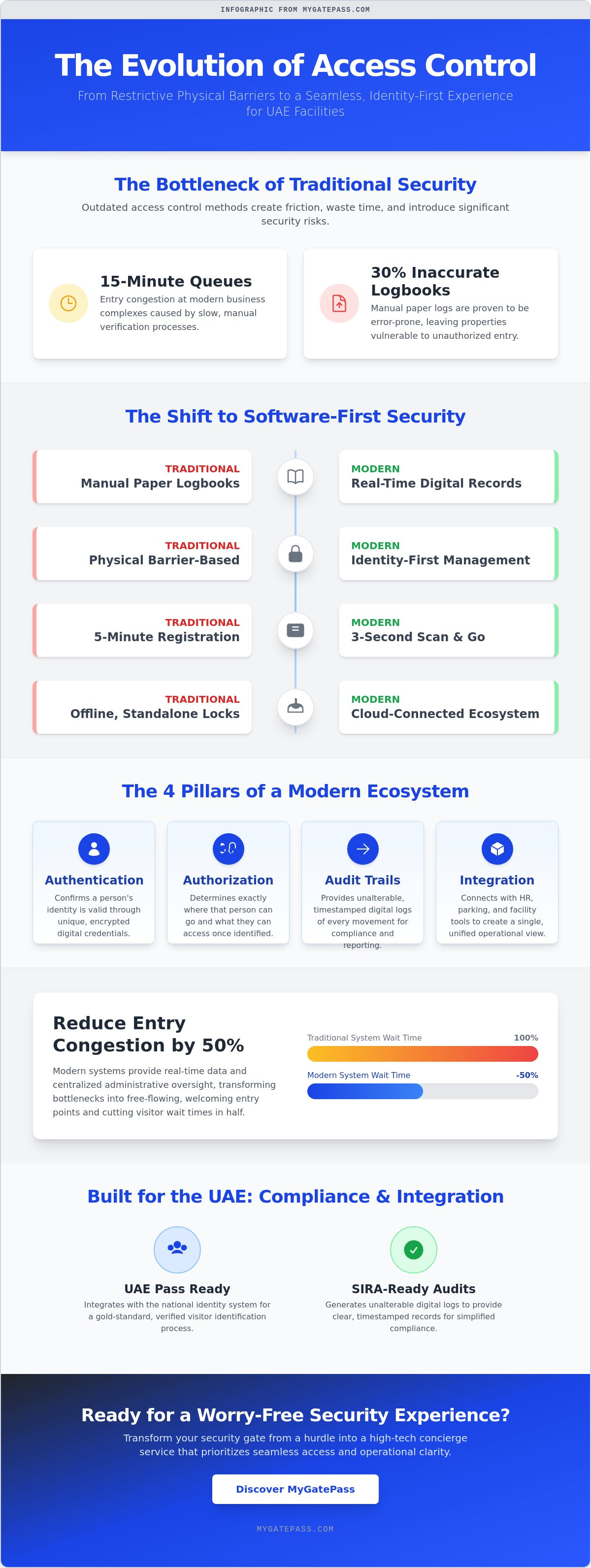
What if your building's front gate was no longer a bottleneck but a welcoming digital handshake? Across modern business complexes, it's common to see 15-minute queues caused by outdated access control technology. You likely agree that manual paper logbooks are often 30% inaccurate based on 2024 facility audits, leaving your property vulnerable to unauthorized entry. Security shouldn't be a hurdle. It's a service.
This guide promises to show you how software-driven solutions are turning security into a seamless, identity-first experience. By 2026, modern systems will move beyond simple locks to provide real-time data and centralized administrative oversight. You'll discover how these tools reduce entry congestion by 50% while ensuring every visitor identity is verified instantly. We'll examine the specific shifts in facility management that make worry-free security a reality for UAE businesses.
Key Takeaways
- Understand the evolution from restrictive physical barriers to identity-first management to foster a secure yet open community atmosphere.
- Compare hardware-centric models with software-first solutions to identify the most scalable and cost-effective security path for your facility.
- Master compliance within the UAE legal landscape by integrating UAE Pass for a gold-standard, verified visitor identification process.
- Discover how modern access control technology replaces outdated paperwork with real-time digital records and seamless mobile-app connectivity.
- Learn how a modular, tablet-based ecosystem can transform your security gate into a professional concierge service that prioritizes human interaction.
Defining Modern Access Control Technology in 2026
Access control technology is the digital and physical framework used to regulate who can enter a specific environment. In the context of 2026, this technology has evolved far beyond simple locks and keys. Modern facilities in the UAE have shifted from "barrier-based" security to "identity-based" management. This means security is no longer just about stopping people at a gate; it's about creating a verified, digital profile for every individual entering a space. By prioritizing identity, firms can ensure that authorized personnel move freely while potential risks are identified long before they reach a physical door.
For professional UAE community management, 2026 marks the definitive end of manual logbooks. Paper-based records are slow, prone to error, and offer zero protection for sensitive data. Digital transformation has replaced these outdated methods with real-time data streams. This shift provides facility managers with "operational clarity," a state where every entry, exit, and visitor interaction is visible on a single dashboard. When you have access to live analytics, you can optimize guard deployments and reduce congestion during peak hours in busy hubs like Dubai International Financial Centre or Downtown Dubai.
The goal of modern access control is to foster a sense of sophisticated simplicity. It’s a move toward a high-tech ecosystem where security feels like a premium service rather than a series of hurdles. This approach values the user's time, making the process of entering a building as smooth as possible.
The Core Mechanism: Identification vs. Authentication
Understanding access control technology requires a clear distinction between identifying a visitor and verifying their credentials. Identification is simply the act of a visitor stating who they are, such as presenting a name or a business card. Authentication is the technical process that proves that claim is true.
- Identification: A visitor arrives and claims they have an appointment.
- Authentication: Authentication is the digital handshake that validates a visitor’s identity through a unique, encrypted gate pass before granting access.
Modern software automates this entire sequence. When a visitor receives a digital pass on their smartphone, the system performs the authentication instantly as they approach the gate. This reduces guard-house friction, turning what used to be a five-minute registration process into a three-second scan. It’s a worry-free experience for the visitor and a robust security measure for the facility.
From Standalone Locks to Connected Ecosystems
The evolution of security has moved from offline, standalone keypads to cloud-connected visitor management systems. In the past, a lock only knew if a code was correct; it didn't know who used it or when. Today, centralized dashboards allow for national-scale management of multiple sites across the UAE. A manager in Abu Dhabi can monitor access events for a sister property in Sharjah in real-time.
This connectivity is essential for creating "seamless" transitions between public and private spaces. Whether it is a delivery driver entering a residential community or an executive arriving at a corporate tower, the technology ensures they move through the environment without unnecessary delays. By integrating these systems, UAE firms transform mundane security checkpoints into a connected community experience that prioritizes both safety and hospitality.
The Pillars of Modern Access Control: Beyond Physical Barriers
Modern access control technology has evolved from simple mechanical locks into a sophisticated ecosystem of data and logic. For UAE firms, this means moving beyond the physical gate and into a realm of digital precision. To build a secure environment, four core pillars must work in harmony:
- Authentication: This is the first line of defense. It confirms a person's identity through something they know, something they have, or something they are.
- Authorization: Once identified, the system determines where that person can go. A delivery driver shouldn't have the same level of access as a senior executive.
- Audit Trails: In a region where compliance with SIRA (Security Industry Regulatory Agency) standards is vital, unalterable digital logs provide a clear, timestamped record of every movement.
- Integration: True security doesn't exist in a silo. It connects with your HR software, parking management, and facility maintenance tools to create a unified view of your operations.
Digital Credentials and Mobile Gate Passes
Plastic ID cards are quickly becoming outdated relics. Modern firms are shifting toward smartphones as the primary access tool because it's a device people rarely leave behind. This transition isn't just about being "tech-forward"; it's about operational clarity. When you use a mobile gate pass, you eliminate the cost of printing physical cards. Research suggests that a medium-sized office can save upwards of 12,000 AED annually just by removing the need for physical card replacements and administrative overhead. Pre-registration allows guests to receive a secure, one-time-use QR code via WhatsApp or email before they arrive. This reduces gate wait times from an average of five minutes down to less than 20 seconds, creating a smooth and welcoming first impression.
The Role of Biometrics and National Identity
The UAE is a global leader in digital identity, and local firms are capitalizing on this by integrating access control technology with biometrics. Facial recognition and fingerprint scanning shift the focus from "what you have" to "who you are." This eliminates the risk of lost, stolen, or shared keys. It's the pinnacle of sophisticated simplicity. Users enjoy a hands-free experience while security teams rest easy knowing that identities are verified against robust databases. This approach fosters a sense of community and safety without the friction of traditional checkpoints. You can explore how these digital tools simplify facility management to see how they fit your specific site needs. By prioritizing the human element of the visit, you transform a mundane security process into a premium experience that values the user's time.
Hardware-Centric vs. Software-First Access Models
Choosing between hardware-centric and software-first models defines the long-term agility of a facility. Traditional hardware-centric systems rely on heavy, on-site servers and proprietary wiring. These setups often demand high upfront investments, with initial installation costs for a standard office block in Dubai often starting at AED 40,000. When security requirements change, these rigid systems require physical interventions and costly technician visits. They don't evolve; they simply age. This creates a cycle of technical debt that can stall a firm's growth.
Software-first access control technology offers a more resilient alternative. By moving the brain of the system to the cloud, UAE firms gain a scalable platform that grows with them. Mobile app integration replaces physical cards, which are lost by 15% of employees annually according to recent industry data. This model is inherently more secure against modern threats. While a physical lock stays the same for a decade, software-driven systems receive automatic updates to counter new vulnerabilities. It's a shift toward a Worry-Free experience that removes the heavy maintenance burden from facility teams, allowing them to focus on people rather than wires.
The Myth of the "Secure Gate"
A physical barrier is only as secure as the data behind it. Many property managers ask why they need advanced software when they already have a functional gate. The reality is that physical barriers are vulnerable to human error. A 2023 security audit found that tailgating accounts for nearly 30% of all unauthorized building entries in commercial hubs. Software-first systems solve this by linking entry points to real-time digital identities. This prevents unauthorized credential sharing and ensures every unlock is logged and verified instantly. It turns a passive barrier into an active, intelligent security node.
Cost-Benefit Analysis of Digital Transformation
The financial shift from CAPEX to OPEX provides significant relief for UAE businesses. Software subscriptions eliminate the sudden, high-cost repairs associated with legacy hardware, which can reach AED 5,000 per controller unit when parts become obsolete. Automating visitor pre-registration cuts down on long queues at the lobby, reducing security manpower costs by 25% for large residential complexes. Operational clarity leads to direct financial savings by allowing managers to identify underutilized zones and reduce energy costs based on precise occupancy data. This data-driven approach ensures that every dirham spent on access control technology also contributes to the bottom line.
Compliance and National Identity Integration in the UAE
Operating a business or residential community in the UAE involves navigating a rigorous regulatory landscape. Federal Decree-Law No. 45 of 2021 on the Protection of Personal Data changed how firms handle visitor information. It's no longer enough to just record a name. You need a system that ensures data is processed legally and stored securely. Modern access control technology turns these compliance requirements into a competitive advantage by automating the heavy lifting of data management.
Digital records simplify everything. During a SIRA (Security Industry Regulatory Agency) inspection or a community audit, having a centralized, timestamped log is invaluable. It eliminates the risk of human error found in handwritten registers. Your team can generate reports in seconds, proving 100% compliance with local security protocols without the stress of manual filing. This transition from paperwork to digital records creates an environment of operational clarity.
UAE Pass: The Ultimate Verification Tool
The UAE Pass is the backbone of the nation's digital transformation. By integrating this tool with visitor management apps via secure APIs, buildings achieve a "verified entry" status that was previously impossible. When a visitor arrives, they authenticate through their app. This process confirms their identity against the national registry instantly. It's a gold standard for security. Sites don't need to hold physical Emirates IDs or scan cards into local databases. This reduces the risk of identity theft and speeds up the entry process for high-profile commercial hubs. Security feels invisible yet remains absolute. Visits. Made Simple.
Data Sovereignty and Resident Privacy
Data sovereignty is a priority for the UAE government. Modern systems use encrypted cloud storage hosted within the country to meet these specific regulatory demands. This ensures that sensitive resident and visitor data never leaves the jurisdiction. Protecting privacy isn't just about following the law; it's about building trust. Transparent data practices show residents that their information is handled with care. By moving away from paper logs, you eliminate the chance of unauthorized personnel viewing visitor lists. The system protects the community while providing a smooth, user-friendly experience for every guest.
Ready to upgrade your building's security? Discover how MyGatePass streamlines compliance for modern UAE firms.
MyGatePass: Orchestrating a Frictionless Access Ecosystem
MyGatePass offers a modular suite designed to redefine community security through sophisticated simplicity. It isn't just a tool; it's a friction-reducing partner that brings operational clarity to UAE property managers. By moving away from fragmented systems, the platform provides a centralized hub where security and convenience coexist. This approach transforms access control technology from a barrier into a welcoming, high-tech ecosystem. It's about creating a "connected community" where every interaction feels smooth and intentional.
The MyGatePass Security App for Personnel
Security teams in the UAE often face the burden of manual record-keeping. MyGatePass shifts guards from outdated paper logbooks to high-tech digital concierge roles. Using intuitive, tablet-based tools, personnel manage entries with precision. Automated credential scanning reduces human error by up to 95% compared to manual entries. Real-time arrival notifications sent directly to residents' phones eliminate the need for disruptive intercom calls. This immediate communication significantly boosts resident satisfaction. Guards can finally focus on hospitality, ensuring every visitor feels they're entering a well-managed facility.
- Real-time Notifications: Instant alerts for resident peace of mind.
- Automated Scanning: Fast, error-free visitor verification.
- Digital Records: Transparent logs accessible at any time for audits.
- Delivery Management: Dedicated modules to handle the high volume of courier traffic in Dubai and Abu Dhabi.
A Future-Proof Solution for UAE Facilities
The MyGatePass Resident App fosters a connected community feel by streamlining daily interactions. Whether it's managing guest lists or tracking staff attendance for domestic workers, the system handles it all. The modular design ensures scalability; a single boutique building in Jumeirah or a national property portfolio across the Northern Emirates can benefit from the same robust infrastructure. This flexibility is vital for firms looking to future-proof their access control technology investments.
Choosing MyGatePass means gaining a partner that understands the future of facility management. The platform’s feature-to-benefit flow ensures every technical update improves daily life. It's about making security worry-free. From reducing wait times at the gate to providing exclusive community perks, the system is always one step ahead. It's time to move past long lines and embrace a smooth, digital-first environment. Experience the future of access control with MyGatePass and unlock a new standard of operational excellence.
Step Into the Future of Community Security
The evolution of facility management in the United Arab Emirates is moving toward a software-first approach that prioritizes human experience over rigid barriers. By 2026, the standard for access control technology will be defined by its ability to blend robust security with daily convenience. You've seen how integrating national identity through the UAE Pass creates a verified, trustworthy environment while removing the friction of manual paperwork. Real-time operational clarity isn't just a luxury; it's a requirement for modern managers who oversee complex ecosystems of visitors, staff, and residents.
MyGatePass provides a cloud-based centralized dashboard that brings every entry point into a single, clear view. Its modular software suite handles everything from visitor registration to security and staff attendance, ensuring no detail is missed. With direct UAE Pass integration for verified identification, you can offer a sophisticated entry experience that feels like a tech-savvy concierge rather than a checkpoint. It's time to move away from long lines and toward a more connected, worry-free community.
Unlock a smarter way to manage your community with MyGatePass
Building a secure and welcoming space for your residents has never been simpler.
Frequently Asked Questions
What is the most secure form of access control technology today?
Biometric verification combined with multi-factor authentication (MFA) stands as the most secure access control technology available. Systems using facial recognition or iris scanning provide a 99.9% accuracy rate, making it nearly impossible for unauthorized users to spoof identities. By linking these biological markers with a secondary digital token, firms in Dubai and Abu Dhabi ensure that only verified personnel enter sensitive zones.
How does UAE Pass integration improve building security?
UAE Pass integration transforms building security by utilizing the nation's official digital identity platform for instant, government-backed verification. It eliminates the need for manual ID scanning at the front desk, reducing check-in times to under 10 seconds. This connection ensures that every visitor has a verified profile, creating a high-trust environment that aligns with the UAE Strategy for Government Services 2021-2025.
Can modern access control systems reduce wait times at security gates?
Modern systems drastically reduce wait times by shifting the registration process to the visitor's mobile device before they arrive. Facilities using QR-code-based entries often see a 75% reduction in lobby congestion. Instead of waiting for a manual logbook entry, guests scan their pre-authorized pass at a digital kiosk and proceed immediately. It's a faster way to manage high traffic during peak business hours.
What is the difference between physical and logical access control?
Physical access control limits who can enter a tangible space, while logical access control restricts entry to digital assets and networks. A physical system manages turnstiles and elevators to keep your office secure. In contrast, logical systems use passwords and encryption to protect company databases. Both layers are essential for a robust security posture in any tech-driven firm operating in the Emirates.
Is cloud-based access control better than on-premise systems?
Cloud-based access control technology is generally superior for modern firms because it offers real-time updates and remote management from any location. Unlike on-premise systems that require expensive local servers and manual maintenance, cloud solutions scale instantly as your business grows. You'll get automatic security patches and the ability to revoke access rights immediately through a centralized dashboard, ensuring constant operational clarity.
How does a mobile gate pass system handle delivery drivers and couriers?
A mobile gate pass system handles couriers by issuing time-sensitive, single-use digital credentials. When a delivery driver arrives, they scan a pre-sent QR code that notifies the host instantly and logs the entry. This process replaces messy paperwork and ensures that outside vendors only have access to specific delivery zones for a predetermined window, which typically lasts between 30 and 60 minutes.
What are the legal requirements for visitor data storage in the UAE?
Visitor data storage must comply with UAE Federal Decree-Law No. 45 of 2021 regarding the Protection of Personal Data. This law requires firms to obtain clear consent before collecting information and ensures that data is stored securely with restricted access. Companies must also follow specific retention periods, often deleting visitor logs after a set timeframe unless a legal justification exists for keeping them longer.
Can I integrate my existing gate hardware with new access control software?
You can typically integrate existing gate hardware with new software by using smart controllers or open API protocols. Most legacy systems in the UAE installed within the last 10 years are compatible with modern cloud platforms through simple hardware retrofits. This approach saves on capital expenditure by skipping a full hardware replacement while still unlocking the benefits of a seamless, digital visitor management experience.


